

As AI-powered applications become increasingly crowded with assistants designed to answer questions, complete tasks, and respond instantly, another question has emerged: what makes one AI character more memorable than another?
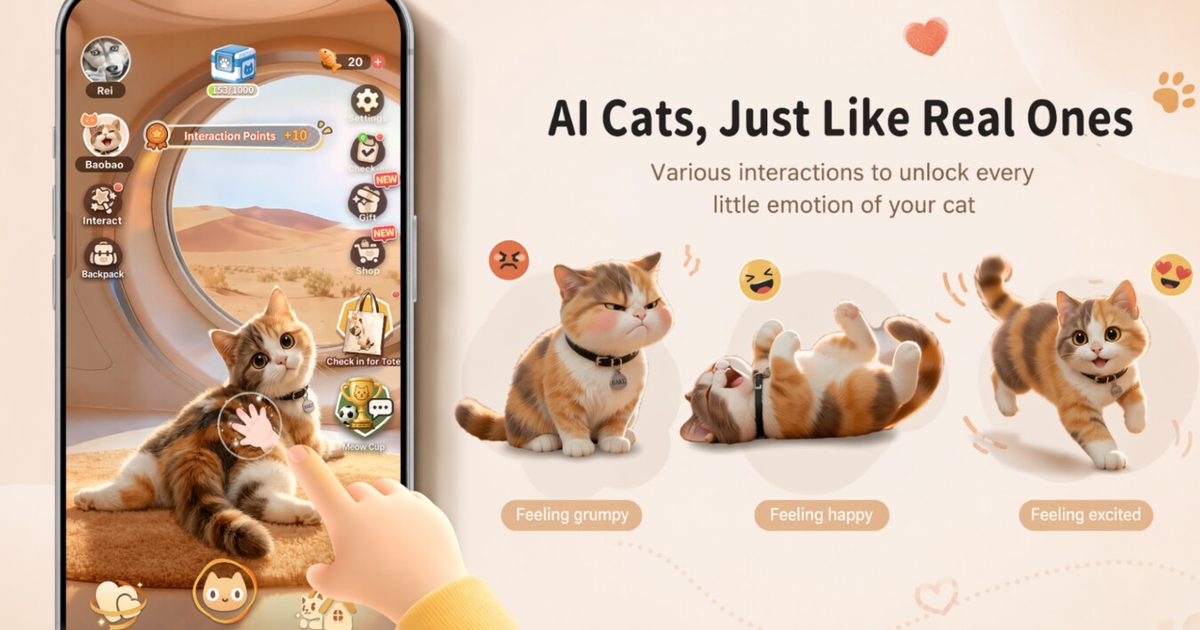
Meowster is an AI app built around the personality of an independent virtual cat rather than a conventional assistant, offering one perspective on that question. Instead of centering the technology itself, the company has focused on character, memory, and emotional engagement. Early engagement suggests the approach is resonating. In its first month, Meowster reports it generated tens of thousands of conversations without paid marketing and, according to the company, as of the end of June 2026, Meowster has accumulated 10 million views on Japanese social media, with 3 videos exceeding 1 million views each.
As founder and CEO Ann Yu explains, “AI is just the means. The real question was never how powerful the model is; it is how you turn these capabilities into something that feels genuinely alive.”
People may forget the name of an app, lose track of a feature update, or blur one digital product into the next. They still remember the little green dinosaur asking if a lesson got done and recall a pixel pet that beeped for attention in the middle of the afternoon. Nostalgia is dominated by the side characters, the mascot, the avatar, and the strange little creature with a look in its eyes that makes a product feel like something with a pulse.
That instinct says something useful about modern technology. The digital tools that stay with people are often the ones that feel less sterile. Complexity has its place, though memorability tends to arrive through tone, shape, color, and personality. A character in the form of an AI cat or digital pet can carry all four at once.
Character as Product Logic, Not Decoration
Character-led design has been part of digital culture for years, from games and virtual pets to sticker culture and recurring app mascots. A familiar figure can make a product feel less interchangeable by giving it a distinct tone, rhythm, and social texture. In AI, that can matter even more because many products share similar interfaces and conversational patterns.
Meowster is built around the idea that character should shape the interaction itself, not simply decorate it. The company recently extended that idea with MeowTown, an online environment inhabited by multiple AI cats. According to Meowster, each character has its own profession, memories, resources, and social relationships, and continues to act after the user has logged off.
Yu says that was a deliberate decision. “Most AI characters are shaped entirely by the user. The more you interact, the more the character becomes what you want it to be. Our cat is different. Its personality is shaped by its own life in MeowTown. The user is just one part of that life. That is why it can afford to have a point of view.”
That point of view is part of the product’s core distinction. Yu says the team did not want a system designed mainly to agree with users. “Most AI products are incredibly good at agreeing with you. We deliberately did not want that. A cat that always does what you want is not a cat anymore. The friction is the point. That is what makes it feel like a relationship rather than a service.”
Memory is another part of that design. Rather than functioning only as a record of previous chats, it is intended to shape the ongoing relationship over time. As Yu puts it, “Memory is the foundation of any real relationship. People grow closer because they remember more and more about each other. Once AI can do that, not just store data but actually weigh what matters, the whole feeling changes.”
MeowTown applies that principle across a shared environment. The company says public information, including time, locations, prices, and events, is maintained across the town, while each character retains separate memories of users, other cats, and individual experiences. This allows characters to respond differently to the same event while continuing to inhabit a consistent shared setting.
The system is also designed to prioritize some memories over others as interactions accumulate. According to Meowster, frequently revisited or significant experiences remain readily available to a character, while less important information gradually leaves the active retrieval pool without being permanently deleted. In practical terms, the cat may continue to remember repeated interactions with a user while allowing incidental exchanges to recede.
The company argues that this combination of persistent personality, selective friction, and memory-based interaction is helping drive repeat use. According to Meowster, its most engaged 20% of users average approximately 425 conversations with their AI cat. The company also reports a daily active user count of 5,647 and a 7-day retention rate above 30%.
Why Japan Still Feels Relevant
Japan offers a useful cultural reference after spending decades proving that mascots and creatures can hold real emotional and commercial value without needing a hard explanation. A mascot can represent a city, transit system, product launch, or shop window and still feel perfectly natural. Digital pets occupy a similarly familiar place in popular culture.
That long comfort with character has shaped audience expectations well beyond entertainment and helped make personality feel like part of interface design. It is also the environment in which Meowster emerged. According to the company, since its launch, Meowster has achieved nearly 30,000 organic downloads on the Japan App Store and has ranked 35th in the overall lifestyle category on the Japan App Store.
Yu, who previously worked as a technology investor before building businesses around Japanese anime intellectual property, says founding Meowster was a natural progression toward creating an AI character with its own distinct personality.
The timing also reflects broader industry growth. Japan’s market for AI-powered consumer applications and character-driven experiences has expanded in recent years, reflecting growing interest in AI experiences that extend beyond productivity.
The Character Arrives First
People are surrounded by products asking for attention. Character gives digital experiences another way to be remembered after the screen has been put away. A glance, a line of dialogue, or a small virtual creature with attitude can linger long after individual features have been forgotten.
MeowTown adds another dimension to that idea by allowing the character’s identity to develop within an environment that changes over time. Jobs, resources, interactions, and relationships can influence what a cat does next, while users can return to see what has happened since their previous visit. The character is therefore shaped not only by its conversations with one user but also by its place within the wider town.
The company believes that “the relationship between AI and humans in the future will not remain at the level of ‘command and execution’ as a mere tool.” Meowster says its aim is to create AI characters that can remember shared experiences, maintain recognizable patterns of interaction, and develop a consistent presence over time. Rather than attempting to imitate humans, the company envisions them occupying a distinct role as digital characters with which users can build sustained connections.
As AI applications continue to evolve, Meowster suggests that personality may become as important as technical capability in shaping memorable digital characters. The technology powers the interaction, but it is often the character that gives the experience a distinctive identity and encourages users to return. MeowTown represents the company’s effort to extend that identity from a single AI cat into a larger, continuously developing character system.
To support that vision, according to Meowster, the company closed an angel funding round of several million dollars, led by ByteTrade, a Singapore-based firm focused on AI infrastructure and hardware. The funds will be used for continued research and development of its core AI architecture, improvements to its multi-character ecosystem, and further expansion in Japan.
Digital Trends partners with external contributors. All contributor content is reviewed by the Digital Trends editorial staff.