




Google Home Speaker
MSRP $99.99
“A delightful smart speaker that’s easy to love.”
Pros
- Gemini makes voice control feel genuinely conversational
- Strong smart home integration
- Better sound than previous compact Google speakers
- Modern, compact design
- Excellent value at $99
Cons
- Advanced features require a subscription
- Best experience requires buying into Google’s ecosystem.
- No display for visual controls or information
Quick Recap
Google just introduced a new Home Speaker powered by Gemini, and it may represent the biggest shift that the company’s smart home lineup has seen in years. This isn’t simply a hardware refresh with improved sound or a new design. Instead, Google is positioning Gemini as the foundation of a smarter home assistant, one that understands natural conversation instead of relying on rigid voice commands. At $99, the new Home Speaker also enters one of the most competitive segments of the smart home market, where it will inevitably be compared with devices like Apple’s HomePod mini.
Having used the speaker for the past couple of weeks, it quickly becomes clear that Gemini is the real upgrade. The hardware itself is a step forward over Google’s previous compact speakers, but the biggest difference comes from how naturally the speaker understands requests and carries on conversations. Rather than forcing you to think about the right command, it adapts to the way you naturally speak.
Google Home Speaker specs: What’s inside the round shell?
| Colors | Berry, Porcelain, Hazel, Jade |
| Dimensions | Product: 3.4″ height x 4.2″ diameter Power Cable: 59.1″ |
| Weight | 0.9 lbs (speaker + captive cable, excludes power adapter) |
| Power Adapter & Ports | Adapter: 30W Type-C USB-PD PPS PDO: 5V/3A, 9V/3A 15V/2A, 20V/1.5A PPS: up to 11V/2.73A, 16V/1.88A, 21V/1.43A Dimensions: 2.3″ H x 1.1″ W x 2.2″ L Weight: 0.1 lbs |
| Memory & Storage | Memory: 1 GB LPDDR4 Storage: 4 GB EMMC |
| Processor | Quad Core A55 2.0 GHz with NPU |
| Speaker & Microphones | Omnidirectional sound with 58mm full-range driver 3 far-field microphones 2-stage mic mute switch (hardware mute) |
| Technology | Gemini for Home, Voice match technology |
| Sensors | Capacitive touch controls (3 touch areas) |
| Materials | Made with at least 37% recycled materials based on product weight 100% plastic-free packaging |
| Smart Home Connectivity | Wi-Fi 6 802.11ax (2.4 GHz/5 GHz) Bluetooth® 5.4 Thread 1.3 border router (2.4 GHz) |
| Smart Home Compatibility | Works with Google Home, Matter Works as a hub for Matter with Google Home |
| Supported OS | iOS, Android |
| In the Box | Google Home Speaker, Power adapter, 59.1″ captive power cable, Quick start guide, Safety & warranty document |
Google Home Speaker design and setup: It’s clean and breezy

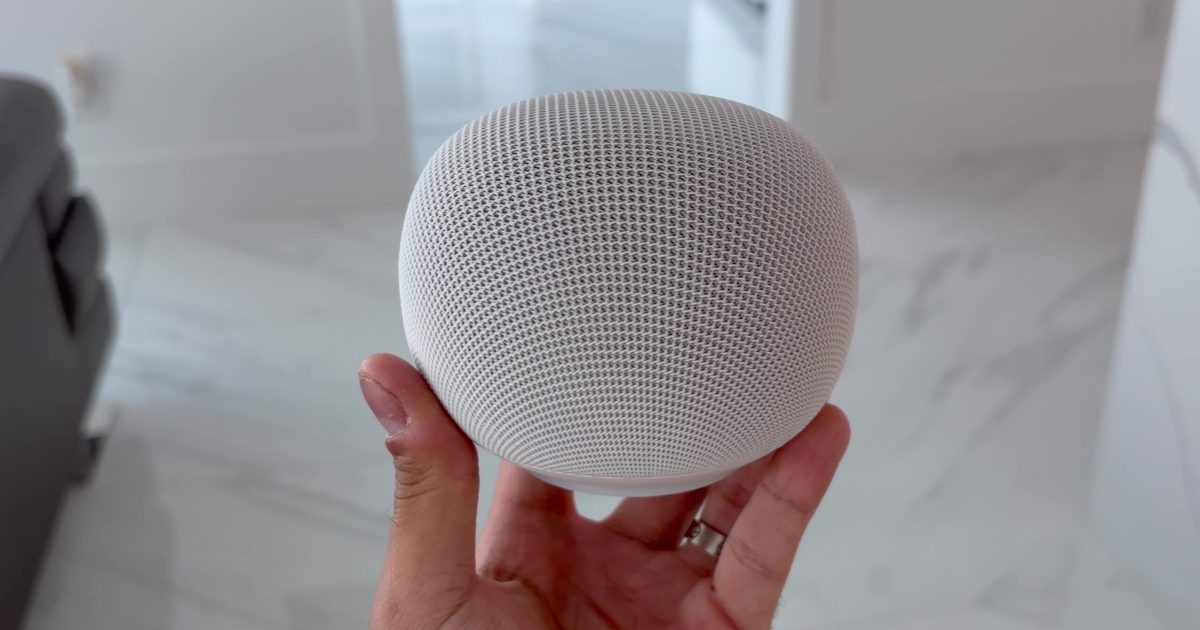
Measuring 3.44 inches tall, 4.2 inches in diameter, and weighing just 0.9 pounds, the new Google Home Speaker is compact enough to blend into almost any space while still feeling more premium than Google’s older Nest speakers. Setup is straightforward. Inside the box, Google includes the speaker, a 30W USB-C power adapter, and a 1.5-meter power cable, with everything configured through the Google Home app.
Google is offering the speaker in four colors: Hazel, Porcelain, Jade, and Berry, with Jade and Berry currently exclusive to the U.S. The Porcelain model used for this review has a clean finish that should fit comfortably into most homes without drawing attention to itself. Overall, the design feels minimal, modern, and understated. Rather than becoming the focal point of a room, it blends naturally into a desk, shelf, or living space. Like much of Google’s recent hardware, recycled materials are used throughout the design, including the 3D-knit fabric exterior, which immediately brings Apple’s HomePod to mind.
One of my favorite details is the dynamic light ring around the base. It changes depending on whether the speaker is listening, processing a request, or responding, so instead of wondering what it’s doing, you always have visual feedback. It sounds like a small addition, but it makes the entire experience feel more alive. Omnidirectional microphones round things out, allowing the speaker to hear requests clearly from across the room without constantly asking you to repeat yourself.
Google Home Speaker interactions: Gemini changes how you use a smart speaker

The biggest shift with Google’s new Home Speaker has very little to do with the hardware. Instead, it comes from replacing Google Assistant with Gemini, and that fundamentally changes how you interact with the speaker.
Previous Google smart speakers worked best when you thought in commands. You would ask it to turn off the lights, set the thermostat, or play music, usually one request at a time. Gemini moves away from that approach. Rather than remembering specific phrases, you simply talk to it the way you would another person. Saying something like, “Set the house up for bedtime,” is enough for Gemini to understand the intent behind the request and carry out the necessary actions. It can also handle multiple requests in a single sentence and even adapt if you change your mind halfway through speaking.
Reasoning is where Gemini begins to separate itself from Google’s previous assistants. During testing, asking whether it would rain during a baseball game didn’t just produce the day’s weather forecast. Rather than simply pulling information, Gemini reasons through the request by combining context from multiple sources. Google calls this real reasoning rather than simply retrieving data, and it is one of the biggest differences between Gemini and the Google Assistant experience that came before it.
Gemini is just as useful for everyday tasks. It can help with reminders, calendar events, shopping lists, and planning your day while supporting natural follow-up questions that build on the conversation instead of starting over each time. Users can also choose from 10 different voice options to personalize how the assistant sounds.
Google is making the core Gemini experience available without an additional subscription. Buyers who purchase the Home Speaker before the end of September also receive six months of Google Home Premium, which unlocks Gemini Live. Instead of issuing commands, you can simply say, “Let’s chat,” and have a full back-and-forth conversation with your home assistant. Premium also introduces more advanced smart home features, including camera search history that lets you ask questions like whether someone left the garage open or whether the dog jumped on the couch, along with Home Briefs, which summarize everything that happened while you were away. Google Home Premium is available in two tiers, with the standard version included in Google AI Pro and the advanced tier bundled with Google AI Ultra

Google Home Speaker sound quality: It’s okay for the mission
Audio has received meaningful upgrades alongside Gemini. Google says the new Home Speaker features improved microphone processing for better voice pickup, true 360-degree sound, and 2.5 times stronger bass than the Nest Mini. Compared to Google’s previous compact smart speakers, the difference is immediately noticeable, making this a worthwhile upgrade for anyone coming from an older Nest Mini.
Stereo pairing is available when using two Home Speakers together, while integration with Google TV Streamer, Nest devices, and Cast-enabled products allows it to become part of a whole-home audio setup. Rather than existing as a standalone smart speaker, it slots neatly into Google’s broader ecosystem. As far as the raw audio quality goes, it avoids the expected pitfall of overtly-processed and synethetic tunes. It can fill a small to medium-sized room with punchy audio without any jarring distortion at high volume levels.
The sound profile is pleasant, in general, it’s sufficiently clear for listening to podcasts and audiobooks. Notably, it excels at mids, which means vocal-heavy tracks and classic music will please you ear canals. On the flip side, don’t expect delicate instrumental separation and at high volumes, complex tracks definitely get a tad muddy. If you seek that kind of audio nirvana, you might want to pay up a little bit and get the Sonos Era 100, or the bigger Google Nest Audio.
Google Home Speaker vs. HomePod mini
Comparison with Apple’s HomePod mini is almost unavoidable since both speakers occupy the same $99 price point. Both feature compact, fabric-covered designs that are meant to blend into a room and are available in multiple colors. The difference lies in what each product is trying to be. HomePod mini feels like a music-first accessory for the Apple ecosystem, while Google’s new Home Speaker is designed as a display-less AI hub powered by Gemini.
Gemini is also where Google creates the biggest distinction. Natural conversations, follow-up questions, and multi-step requests all feel more fluid than the command-driven interactions that have traditionally defined smart speakers. Apple has introduced Siri AI, but the current HomePod mini will not support those new capabilities. Anyone looking for Apple’s next-generation AI assistant will likely need to wait for future HomePod hardware.

Buyers already invested in HomeKit will still find plenty to like about the HomePod mini, but Google’s approach feels more flexible today. Gemini supports multi-action commands, context-aware conversations, and AI-driven automation, making interactions feel less reactive and more conversational.
Audio performance is another area where the two speakers differ. HomePod mini delivers clean, balanced sound for its size, while Google’s new Home Speaker focuses on stronger bass, wider 360-degree room-filling audio, and stereo pairing. Neither is intended to replace a dedicated speaker system, but Google places greater emphasis on creating a more immersive listening experience throughout a room.

Should you buy
Stepping back, this is more than a speaker upgrade. Google is rethinking what a smart home assistant should actually feel like. The future is not about commands or repeating yourself. It is about natural interactions, and that is ultimately the biggest selling point of the new Google Home Speaker. For its size, the sound quality is surprisingly punchy, and it performs pretty well if you’re more into listening to podcasts or music without deep audiophile expectations.
It, however, excels with arguably the smartest on-device AI assistant out there. Voice interactions are natural, the cross-device interplay is rewarding, and it can actually get work done across different apps and services, if you have linked the respective accounts with your Google account. The biggest caveat is that some of the smartest capabilities are locked behind a subscription, but if you merely need a no-frills tiny smart speaker, the Google Home Speaker’s latest avatar is as good as it gets.
Why not try
Amazon Echo Dot Max — If audio quality is your top preference, the two-way speaker fitted on the latest Amazon Echo Dot Max is right up your alley. Packing a dedicated woofer and tweeter, it delivers a surprising amount of bass and clarity. The cool Omnisense system brings presence awareness to the table, and it also offers support for multiple smart home protocols, including Matter and Thread. On the audio side, it even adapts to the layout of your room or home space. Plus, the new Alexa+ assistant is a meaningful upgrade.
Apple HomePod mini — The direct rival to Google’s speaker, Apple’s HomePod mini offers a similar design and build profile. It offers a signature audio output that is pleasing, though not hte loudest or room-filling kind. Where it wins is the deep Apple ecosystem integration, and finally, a much smarter Siri AI that is now ready to pull intelligence from — and get work done across — third party apps. But if you have an Android device in your hands, it’s not the best bet because a healthy bunch of features get locked.
Sonos Era 100 SL — In case you’re chasing a true audio pedigree, the Sonos Era 100 SL is arguably the best bet, even though it’s slightly more expensive. It delivers more refined audio, deeper bass, wider soundstage, and stereo separation, thanks to the combination of dual-angled tweeters and a bigger mid-woofer. It seamlessly allows multi-room audio playback and offers meaningful EQ tuning, as well. The assistant situation takes a hit, however, and the Sonos app still needs some work.
How we tested
We tested the Google Home speaker for a couple of weeks. In that span, it was linked to a personal Google account for accessing all the Gemini smart home features and automations. The audio quality was tested standalone, and to get a better perspective, it was also compared against the latest Apple HomePod mini. While testing, we focused on three core areas for qualitative evalauation, and they include raw sound quality, responsiveness and accuracy of the onboard AI assistant, and the wider cross-device weaved around it.
For audio quality evaluation, we played a variety of songs across difference genres to gauge how it handles different frequency ranges. Additionally, the onboard AI assitant was tested by throwing natural language queries its way, ranging from day-to-day smart device controls to knowledge delivery. We focused on accuracy and latency as the key metrics to assess the digital assistant’s efficacy. For the overall setup, we tested it across different positions under varying network and cross-device syncing environments.