



Close Menu
Tech Savvyed
  • Home
  • News
  • Artificial Intelligence
  • Gadgets
  • Apps
  • Mobile
  • Gaming
  • Accessories
  • More
    • Web Stories
    • Spotlight
    • Press Release

Subscribe to Updates

Get the latest tech news and updates directly to your inbox.

What's On
Samsung’s next iPad Pro rival just leaked with a faster chip and a stubborn notch

Samsung’s next iPad Pro rival just leaked with a faster chip and a stubborn notch

17 July 2026
This smart knitted fabric can flip switches, count your steps, and even change shape

This smart knitted fabric can flip switches, count your steps, and even change shape

17 July 2026
Meta AI will bring parents into the loop when teens mention self-harm

Meta AI will bring parents into the loop when teens mention self-harm

17 July 2026
Facebook X (Twitter) Instagram
Tech Savvyed
SUBSCRIBE
  • Home
  • News
  • Artificial Intelligence
  • Gadgets
  • Apps
  • Mobile
  • Gaming
  • Accessories
  • More
    • Web Stories
    • Spotlight
    • Press Release
Tech Savvyed
Home»News»This smart knitted fabric can flip switches, count your steps, and even change shape
News

This smart knitted fabric can flip switches, count your steps, and even change shape

News RoomBy News Room17 July 20263 Mins Read
This smart knitted fabric can flip switches, count your steps, and even change shape
Share
Facebook Twitter Reddit Telegram Pinterest Email

For most of us, knitting brings to mind sweaters, scarves, and perhaps an ambitious grandmother determined to make winter more fashionable. Researchers at Harvard University, however, have a far more futuristic vision. They’ve transformed ordinary knitted fabric into a programmable material capable of changing shape, acting as an electrical switch, sensing movement, and potentially forming the foundation of tomorrow’s wearable technology.

The research, published in Advanced Functional Materials by scientists at the Harvard John A. Paulson School of Engineering and Applied Sciences (SEAS), demonstrates how machine-knitted textiles can “snap” between multiple stable shapes without relying on motors or rigid mechanical parts.

In simple terms, these fabrics behave less like clothing and more like soft robots.

A knitted fabric that remembers its shape

The breakthrough revolves around a concept known as multistability, where an object can naturally settle into more than one stable configuration. Think of a light switch. It doesn’t stay halfway between on and off. Instead, it snaps cleanly into one of two positions.

The Harvard team managed to recreate that behaviour using nothing more than specially selected elastic yarns and industrial knitting techniques. Led by Kausalya Mahadevan, now a postdoctoral researcher in Professor Katia Bertoldi’s lab, the project combines principles of textile engineering with nonlinear mechanics, an area of physics that studies how materials bend, buckle, and snap under force.

Instead of moulding plastics or engineering complex polymers, the researchers relied on weft knitting, the same manufacturing process used to produce everyday garments like hats, gloves, and sweaters. By carefully arranging different elastic yarns using a technique called plating, they created dense knitted structures that naturally curl into three-dimensional forms.

The result is a textile that can repeatedly change shape while reliably returning to predefined positions.

From smart clothing to programmable interiors

The team didn’t stop at creating shape-shifting fabric. To demonstrate practical applications, researchers integrated conductive yarns into the textile, allowing it to function as a soft electrical switch. One prototype turned an LED on and off simply by snapping between two stable positions.

Another transformed the fabric into a wearable motion sensor. Mounted over a person’s knee or elbow, the textile detected each snap and transmitted the motion to an Arduino controller that could count steps. Perhaps the most eye-catching demonstration was a reconfigurable lampshade. By stretching different parts of the knitted structure, users could activate separate switches that changed the lamp’s colour, all without traditional buttons or electronics dominating the design.
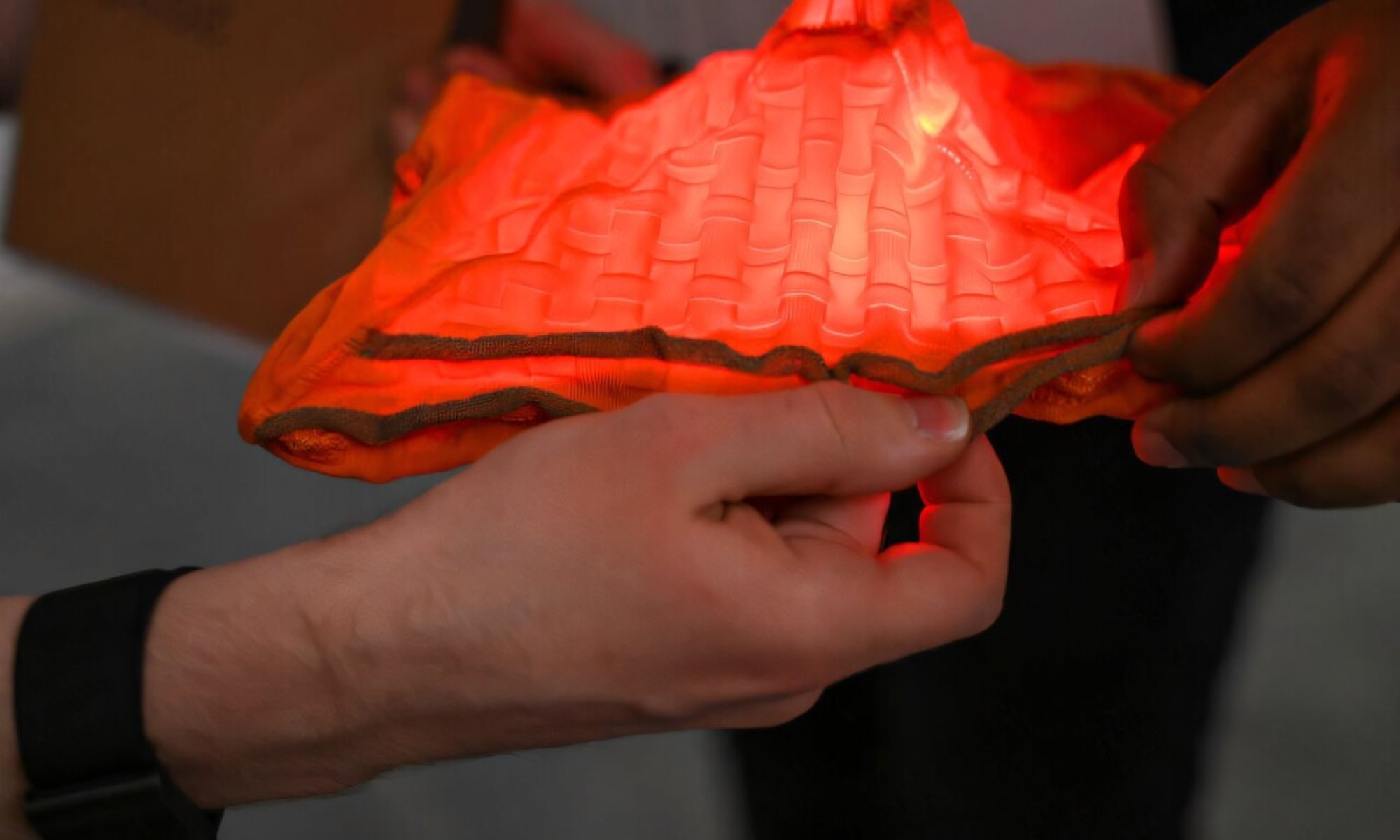
A reconfigurable lamp shade with multistable switches that correspond to different colors of light.

One of the biggest advantages is scalability. The researchers developed these textiles using machines already found in commercial garment factories, meaning the technology doesn’t require exotic manufacturing techniques to reach production. Beyond clothing, the work pushes programmable textiles closer to the rapidly growing field of mechanical metamaterials, where structures derive their unique abilities from geometry rather than complex electronics.

The long-term vision is even more ambitious. The researchers imagine fabrics that quietly monitor body movement, provide tactile feedback, respond to environmental changes, or physically morph into entirely new shapes on demand. Smart textiles have existed for years, but they’ve often relied on rigid sensors and bulky electronics stitched into fabric. Harvard’s approach suggests the fabric itself could eventually become the technology. That’s a subtle shift, but one that could redefine everything from wearable health trackers to adaptive furniture and responsive interiors.

Share. Facebook Twitter Pinterest LinkedIn Telegram Reddit Email
Previous ArticleMeta AI will bring parents into the loop when teens mention self-harm
Next Article Samsung’s next iPad Pro rival just leaked with a faster chip and a stubborn notch

Related Articles

Samsung’s next iPad Pro rival just leaked with a faster chip and a stubborn notch

Samsung’s next iPad Pro rival just leaked with a faster chip and a stubborn notch

17 July 2026
Meta AI will bring parents into the loop when teens mention self-harm

Meta AI will bring parents into the loop when teens mention self-harm

17 July 2026
ChatGPT will now remind teens to take breaks and give parents more controls

ChatGPT will now remind teens to take breaks and give parents more controls

17 July 2026
This gaming mouse has a Noctua fan inside, and it finally has a launch date

This gaming mouse has a Noctua fan inside, and it finally has a launch date

16 July 2026
Galaxy Z Fold 8 Ultra: Everything we know about Samsung’s next flagship foldable

Galaxy Z Fold 8 Ultra: Everything we know about Samsung’s next flagship foldable

16 July 2026
ChatGPT’s new search tool saves you from digging through old chats, files, and images

ChatGPT’s new search tool saves you from digging through old chats, files, and images

16 July 2026
Demo
Stay In Touch
  • Facebook
  • Twitter
  • Pinterest
  • Instagram
  • YouTube
  • Vimeo
Don't Miss
This smart knitted fabric can flip switches, count your steps, and even change shape

This smart knitted fabric can flip switches, count your steps, and even change shape

By News Room17 July 2026

For most of us, knitting brings to mind sweaters, scarves, and perhaps an ambitious grandmother…

Meta AI will bring parents into the loop when teens mention self-harm

Meta AI will bring parents into the loop when teens mention self-harm

17 July 2026
ChatGPT will now remind teens to take breaks and give parents more controls

ChatGPT will now remind teens to take breaks and give parents more controls

17 July 2026
This gaming mouse has a Noctua fan inside, and it finally has a launch date

This gaming mouse has a Noctua fan inside, and it finally has a launch date

16 July 2026
Tech Savvyed
Facebook X (Twitter) Instagram Pinterest
  • Privacy Policy
  • Terms of use
  • Advertise
  • Contact
© 2026 Tech Savvyed. All Rights Reserved.

Type above and press Enter to search. Press Esc to cancel.