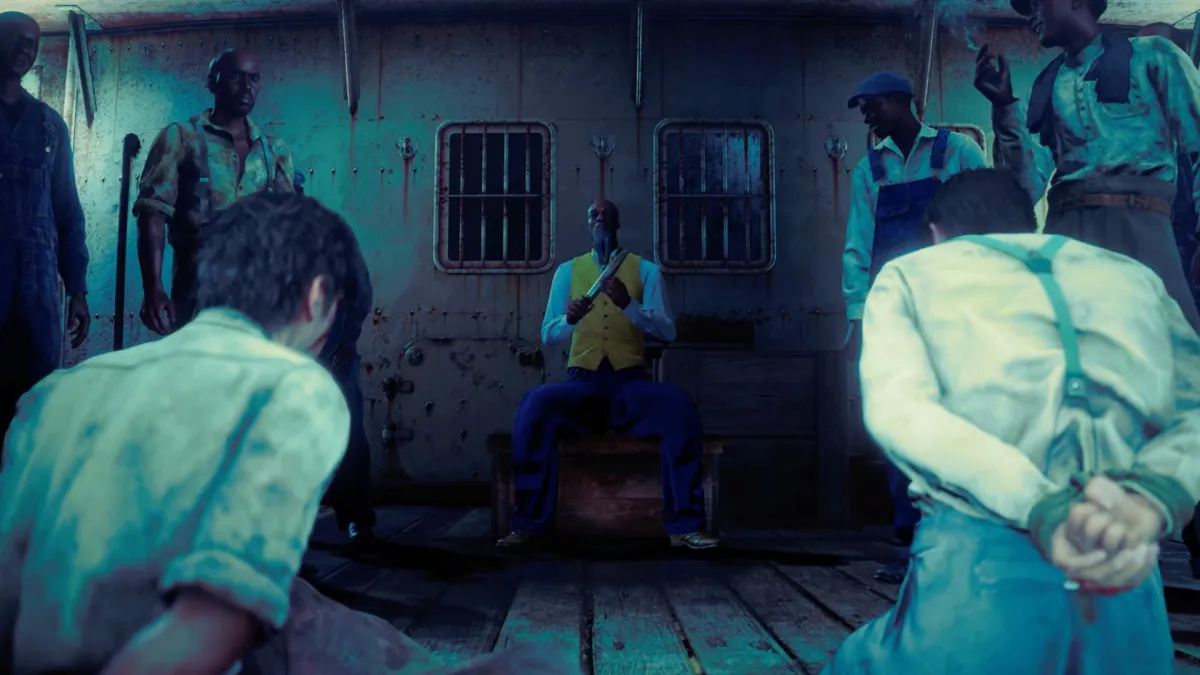



A big part of me wants to forgo explaining what makes The Incident of Galley House great for fear of revealing too much; to just say “trust me, play it. It’s good.” Unraveling the truth behind the unsolved deaths of a group of people gathering at a mansion one stormy night in 1936 is engrossing and inventive, with a tale that keeps you guessing until its final moments. Although I didn’t get all of the answers I wanted, I was immensely impressed with the revelations I did uncover and the journey to find them.
The Incident of Galley House is a reimagined take on the 2025 horror text game, Type Help, by William Rous that has been remastered and expanded by Evil Trout, creators of The Roottrees Are Dead. Players control a researcher who visits the condemned Galley House where multiple dead bodies were discovered decades prior; the causes of their deaths are unknown. Using a machine capable of reconstructing scenes from the past to watch in the present, you piece together the conversations, actions, and whereabouts of each person during the ill-fated hours leading to their demise. The present-day premise was fascinating enough to draw me in, but the events of the past hooked me. A man is invited to Galley House by someone named Rupert Galley, but none of the residence’s many guests have heard of this supposed host. This begs many questions: Who is Rupert Galley, and why did he invite this man? Why have these visitors gathered this night? And, most importantly, why and how is everyone dying?
Like The Roottrees are Dead, The Incident at Galley House quickly becomes a fun, all-consuming exercise of gleaning context clues from conversations and physical evidence to uncover new information that gradually reveals the full events of a 26-segment timeline. Doing so requires engaging with an inventive system of correctly entering numerical codes that indicate the location, time, and people (who are only identified by a number until you discover their names) to find scenes matching those criteria. The experience of deducing who did what and where reminds me of Clue; I got a kick out of figuring out if, for example, two characters were in the living room during a specific time based on information I learned from a different, chronologically later scene I happened to unlock first.
I appreciate how much flexibility The Incident at Galley House allows for filling out the timeline. You can follow each character’s night one at a time, focus only on reaching the end of the timeline by advancing numerous character threads (and backfill missing scenes later), or do your best to learn every character’s whereabouts chronologically before moving too far ahead. I enjoy the agency in how to approach the investigation, and the game is constructed to allow multiple paths to solving its problems. The story is an immaculately well-written web of clues and references that rewards you for paying attention to not only what’s being said (both at face value and the subtext) but also the visual elements of a scene and the layout of Galley House’s many areas, which in themselves must first be discovered. Revisiting a curious line of dialogue with new perspectives on the person or situation to find information hidden in plain sight never stopped feeling satisfying or, in some cases, mind-blowing.
Since you follow 26 scenes for each of the game’s dozen or so characters, it’s easy to become overwhelmed by the amount of dialogue and information you have to keep track of. Thankfully, The Incident at Galley House offers many helpful tools to make sense of it all. The notepad from The Rootrees are Dead returns, letting you take in-game notes and save quotes directly from dialogue transcripts. Scenes can be paused so you can re-read and highlight key text before resuming them. A search engine surfaces conversations based on keywords, and you can even place markers on the timeline to indicate events, such as a character death, at a glance. The Incident of Galley House also communicates how many locked cinematics remain discoverable in each scene, which was one of my favorite time-saving features from The Rootrees are Dead. Though I didn’t need to use every tool often, if at all, I was happy to have them.
You don’t need to find every scene to solve the mystery, but I was so fascinated by not only the overarching story, but also the smaller questions surrounding Galley House’s cast that I obsessively played until I was sure I’d seen everything. The voice performances are generally good, save for some weirdly muted reactions whenever someone learned of another’s death that sometimes took me out of the moment. I enjoyed getting to know Galley Houses’ colorful visitors and grew to like some of them enough that I felt a growing existential dread knowing they wouldn’t make it out of the house alive. Speaking of dread, the game’s eerie vibes and presentation add a welcome layer of creepiness to the already dark subject matter – and the game taps into its unsettling atmosphere for some effective hair-raising moments.
The Incident at Galley House constantly made me reevaluate my theories and approach, and several big twists spurred my search for answers throughout many late-night sessions. Sadly, I found the conclusion to be a mixed bag. The story purposely withholds the biggest explanation I’d been searching for while still offering enough significant ancillary explanations to avoid falling completely flat. It’s an artistic choice that may resonate with some, but after so many hours of searching and concocting numerous wild theories, I wanted a more concrete answer than what the game provides. Still, I had a blast figuring out the fates of these doomed souls, and I’d wager any puzzle or adventure game fan will too.