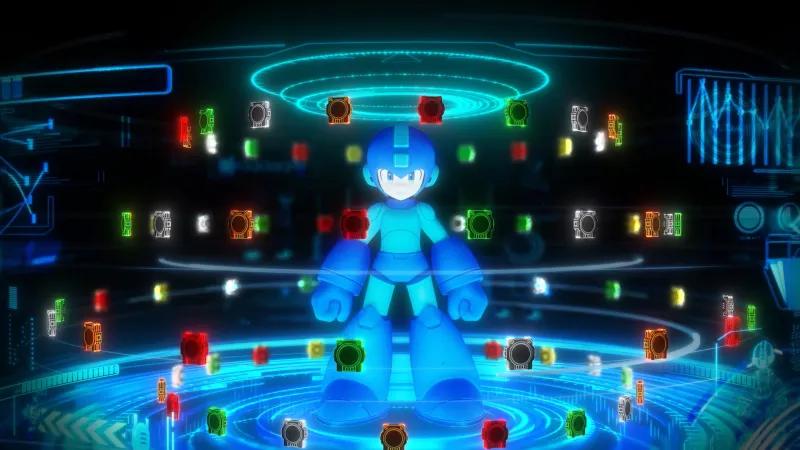



Since its announcement, Capcom has made it fairly clear that despite the Dual Override subtitle, this entry in the Mega Man series is not a spin-off. It is a mainline Mega Man game despite being the first to not end in a number, but I wanted to be completely sure. “Yes, that is correct. This is part of the mainline Mega Man series,” producer Hiroyuki Minamitani (who says Zero is his favorite Mega Man game) told me during an interview following some hands on with the game at Gamescom.
Mega Man series producer, Shingo Izumi (Star Force: Leo/Dragon/Pegasus is his favorite Mega Man game) says that it really comes down to making sure new players who maybe discovered Mega Man through Super Smash Bros. Ultimate or Fortnite (or maybe even the recently released Pragmata skins) aren’t intimidated by history. “As the number increases over time, certain players who have never had a chance to play past Mega Man games may feel some sort of resistance as we feel many new players will be joining in with Dual Override,” Minamitani says. “We felt that we want the title to be more approachable for that audience, as well. So, the title is a combination of the main title and the subtitle, as well. […] We have hope that people introduced to Mega Man outside of Mega Man games will hopefully give Dual Override a shot now that they’re familiar with the character.”
From left to right, Dual Override producer Hiroyuki Minamitani, director Shinya Ikuta, and Mega Man series producer Shingo Izumi
That effort to welcome new players to a mainline Mega Man game seems to extend to the story, as well. Mega Man has never had a complicated story, but it has maintained a canon of sorts across its 11 games. I don’t think we can expect any unexpected narrative revelations. “The Dual Override story kind of stands alone within the entire canon. I don’t think there is a chronological aspect to it, but it is a standalone story that fits within the overall Mega Man world without having to play the others,” Minamitani says. It will have plenty of callbacks and references to past games, though, as it is intended to be a celebration of Mega Man’s 40th anniversary.
One of the ways this manifests is in a new structure. I played through three stages leading up to a final conformation with Twinkle Girl – a first for a Mega Man game – and each of those three stages featured a boss. The second stage boss was Astro Man R, which Mega Man even commented before the fight started that they made a copy of him. Astro Man was a boss in Mega Man 8.
“If you have played other Mega Man titles in the past you might notice that as you progress through the stage, things become more and more challenging as you get further along to the end of the stage,” director Shinya Ikuta (Mega Man 2 is his favorite) says. “That’s when you feel that sense of accomplishment for defeating the boss. For this title we wanted to provide more segmented senses of accomplishment so you feel that after you defeat the boss at the end of that particular area within the entire robot master stage.”

The intention is effective as I did, in fact, feel accomplished as I made it through each of the difficult (but not too difficult) stages, each being shorter than the typical Mega Man level, but each still full of pattern recognition and combat challenges. It also just means more room for more bosses in general. “Yeah, exactly. That creates an opportunity to include more than just the brand new bosses. There is an opportunity for returning bosses, going back to the decision of, what can we do to celebrate the 40th anniversary,” director Ikuta says.
Among the bosses I played, I had the most trouble with Twinkle Girl, an exuberant performer who fires off exploding fireworks as a main attack, but does plenty of moving and dashing which also must be avoided.
The titular Dual Override ability allows players to build up a meter to activate some limited, extra firepower. I had it set to activate automatically when I reached a certain low health threshold, which I liked. It gave me a “one last shot!” feeling without reducing the challenge too much. Even if you’re shooting stronger blaster shots, your health is still low, so you still need to play defensively. In Dual Override mode, if you can charge your weapon up enough, you also can fire an even more powerful shot. I appreciated the Dual Override mode and definitely see myself activating it basically whenever it is available. I also appreciate that the flashy cutscene that plays when you activate it can be skipped.
I enjoy the core Mega Man games, and I walked away from Dual Override eager to see the rest and what kinds of new bosses it will offer. But my heart will always belong to Mega Man X. The last time we received a new mainline Mega Man X game was X8 in 2004. Mega Man may be celebrating 40 years, but I am commiserating 22 years of no proper new Mega Man X games.
“From my perspective, yes, that is something we would definitely love to visit,” series producer Izumi says when I ask not if one is being worked on or if there is anything to tease, but rather, if a new X game is something he would be open to at least considering. “Mega Man X is an important series within the Mega Man brand. We definitely value that series, and if there is a chance, we would always love to consider that.”