




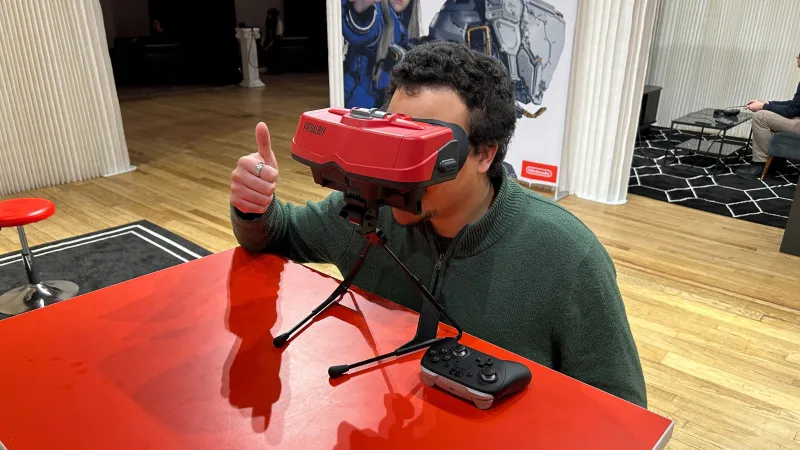
By all accounts, I am not the target audience for the Virtual Boy. The ancient VR console was launched and subsequently discontinued years before I was born. I’m extremely prone to motion sickness, and I wear glasses, which seldom fit in gaming headsets. Also, word on the street was that the console sucked, and that I wasn’t missing out on much.
As such, I’ve never been interested in even trying it, and haven’t had many opportunities, but that changed last week. Nintendo flew me out to New York to play some upcoming Switch 2 titles, and I knew I had to do my due diligence and try the new Switch 2 peripheral and the accompanying library of Virtual Boy games. I entered the event, and after procrastinating by playing basically every other game present, I peered into a pair of plastic ruby-colored lenses.
And honestly? It was kind of cool.
Many of the complaints about the Virtual Boy are still valid. It’s a headset with legs, so you can only play it if you’re sitting at a table with the correct height. Nintendo’s representatives had an adjustable table ready for the demo, but the best the average person can probably do is an adjustable desk chair. I also can’t imagine I’d love leaning into one of these things for hours at a time, but I didn’t have the option on the day of the event.
That said, it didn’t make me motion sick or give me a headache, and I’ll typically have motion sickness triggered within minutes of starting a game, VR, 3D, or otherwise. I suspect it has to do with the higher quality screens developed over the last 30 years, as I didn’t have to strain my eyes to see what was going on. To that end, my glasses also fit into the headset just fine. I wear wide frames, so I bet most pairs would fit, but I heard from another attendee that she had trouble with her glasses, so it probably varies by person. Still, I was able to wear it comfortably, and the visor successfully blocked out any of the room’s overhead lighting.
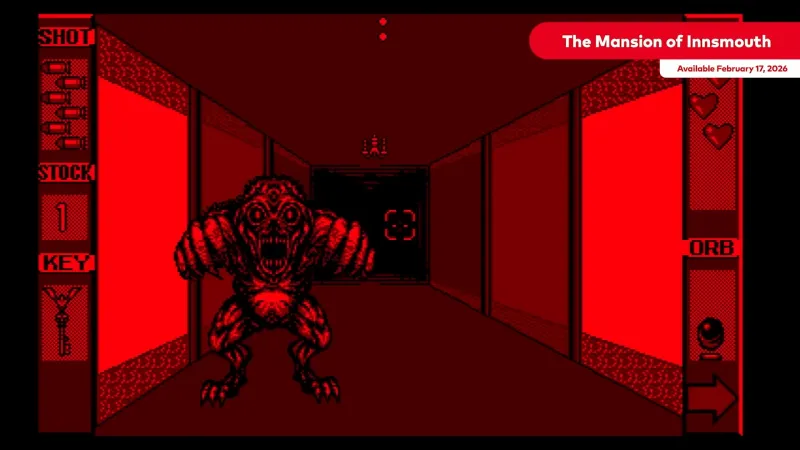
The actual gameplay experience was similarly positive. The Virtual Boy is an odd, gimmicky console with genuine 3D graphics, thanks to its stereoscopic lenses. It was cool to see developers from the mid-90s being creative with the newly added depth, especially as someone with a lot of nostalgia for the 3DS. Landing 3D blocks in 3D Tetris is surprisingly challenging, and Virtual Boy Wario Land uses the background as a secondary area to jump into and side-scroll through.
I also played a bit of The Mansion of Innsmouth (known as Innsmouth no Yakata in Japan), which is coming to the US for the first time with this classics collection. I enjoyed it less, partially since it didn’t make use of the 3D as effectively as the other games I played, but after only a few minutes with it, I can’t make a complete verdict.
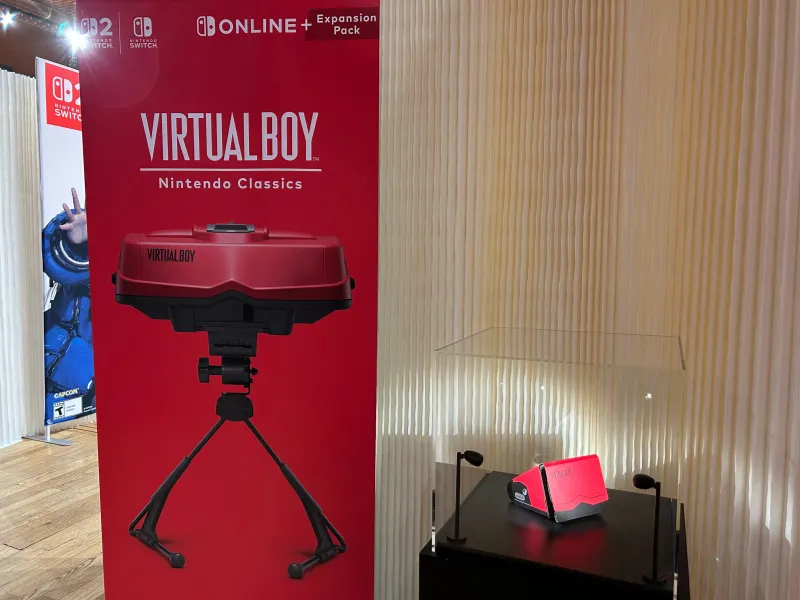
A cardboard Virtual Boy on display
I did not get a chance to play with any of the most recently announced quality-of-life features, like the option to change red pixels to another color or the rewind feature. Both features are coming later in the year, so this isn’t a huge shock. I was far more disappointed, however, that I didn’t get a chance to try out the weird little cardboard headset, which I’m endlessly curious about. They had one in a glass display, though, and it seemed much smaller in person. At $24.99, it’s far more affordable than the proper model, and I’m not quite enthusiastic enough about my experience to get the $99.99 plastic peripheral, so I hope the cheaper model is at least comparable to use.
I’m far from a Virtual Boy convert, but I’m definitely not a hater either. People speak so poorly of the 1995 model that I fully expected to immediately reject the Switch 2 version, but I came away mildly impressed. When the baseline expectation is “headache, neck pain, and nausea” but the actual experience is “huh, pretty neat,” I think it’s fair to say this exceeded my expectations. It’s far from a perfect device, but it very well may be the best way to revisit Nintendo’s worst console.


