




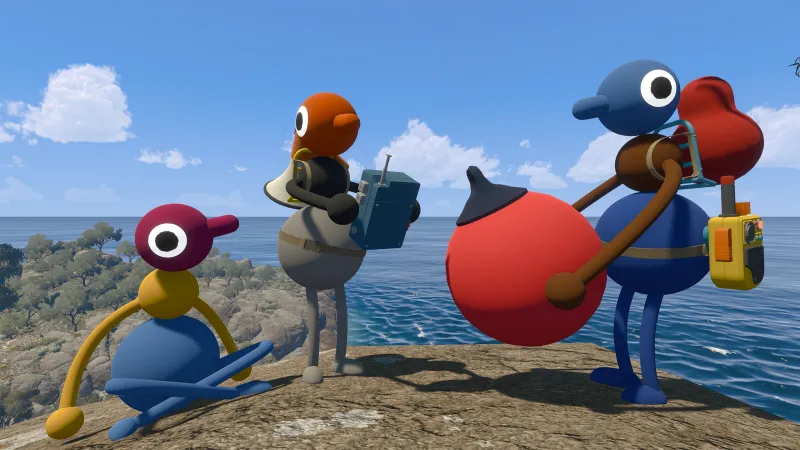
Confetti, friends, paint and noisemakers; a sunset over the ocean after solving a series of puzzles. Big Walk is filled with little bits of interactivity, interspersed throughout a wide landmass of structures and mysteries. It is a world you want to trek across, stopping and pausing along the way, with a good group of friends.
I spent some time exploring Big Walk in a preview session at publisher Panic’s Portland offices, as a preview of the team’s plans to eventually open the same playtest up to the public. After a brief introduction, I sat down at a computer terminal — complete with immersive hood and lights — and spent around the next 90 minutes or so trying to figure out Big Walk with three other pals.
Big Walk is, as developer House House describes it, a “walker talker.” (I did ask about the overused term “friendslop,” though its inception postdates the start of development on Big Walk; they like the friend part, but not so much the slop.) You, and at least one friend but up to 11, are spawned into a room on an island and let loose. From there, the world is yours to explore. A jungle gym-like area taught us basics like sliding, lifting, and pointing, and then we could go wherever our hearts collectively desired.
House House tells me the concept of Big Walk actually came from a desire to spend time together during a time when most couldn’t: the COVID-19 lockdowns.
“So this is 2020. We’re all stuck inside our houses, not seeing each other,” game developer Nico Disseldorp says. “And the way that we’re connecting most is by playing video games with each other a couple times a week, and getting this kind of sense of togetherness from that.”
As House House wrapped up production on the two-player mode for its previous project, Untitled Goose Game, Big Walk wound up feeling natural. It spoke to the yearning they felt for connection and togetherness.
Setting out, my avatar — which we dubbed birds, though there’s no confirmation whether or not they are birds — jogged alongside my three friends, and we came across a giant crane with a clamped object and button at the top. After a few earnest attempts at knocking the object down with whatever makeshift projectiles we could find, we stacked up and made a bird-tower, letting the top bird tap the button and un-clamp our objective: a gourd-like item. Some confetti shot out, and we celebrated.
This wound up being an instructive puzzle for understanding how House House plans to scale Big Walk. There are three “modes” that groups can play in: two-player, three-player, and four-or-more, up to a maximum of 12 players. For two players, the crane might be a lower height than it would be for four or more. Broadly, you can expect a similar experience across the game, but puzzles might be altered to accommodate the player count for duos or trios.
As for why groups are capped out at four players? Well, on the one hand, House House says coordinating five or more people started to get unwieldy. But with a big group, players could start to split up and go off on their own. They could have jobs, or some could simply watch others complete a task, helping from the sidelines. Groups could splinter off, complete a challenge, then come back with the reward and a story to tell the other.
House House says the team even wants to encourage some of that splitting up. Some challenges require players to form small groups and complete puzzles across vast expanses. And some tools naturally encourage splitting up by letting players keep in contact: a whiteboard, for example, or fireworks, could help with nonverbal communication across vast distances.
Comms were surprisingly expressive and adaptive in my playtest, too. While proximity voice chat was the natural option, the text chat and other communication options — even just pointing and gesturing with your avatar — worked incredibly well, and even started to add some physicality to our vocal discussions, as we could point things out to friends while talking about them. Some puzzles even start to revolve around limited communications, where players might not be able to talk to each other and have to gesture, or use alternative means.
“Once you have this rich way to communicate with each other, taking away limited aspects of that, and making you use the others, is actually a really good way to get you thinking creatively and get you kind of playing and having fun, and like exploring the boundaries of those puppets,” game developer Stuart Gillespie-Cook says.
Also, you’ll need to bring your own friends. While House House and Panic are planning a launch later this year for PC and PlayStation 5, with cross-play between the platforms, you won’t be able to matchmake into other people. You’ll have to invite friends to play with you. House House says they imagined Big Walk as a group game, similar to a recurring Dungeons & Dragons session, that you might play for a few hours at a time over several sessions.
My time in Big Walk flit by in what felt like minutes. The little interactive bits, like music stations or fiddly tools, were a blast. The puzzles were pitch-perfect, often requiring us to group up, discuss, and then collaborate for a solution. Just as often, though, I loved the little moments of talking and walking. We’d start making jokes, or discussing what we thought we’d need to do next, or even just making funny noises and singing. It really did feel like a Big Walk with some pals, in a virtual space.
“The walk’s not there for no reason,” Disseldorp says. “That’s the negative space, that’s the space for you to have your own fun and do your own thing in. So everything’s nicely far away, and it’s enough time for in between for you to kind of get a break, catch your breath, start talking to each other again, rather than this kind of unrelenting, ‘okay, what’s the next challenge?'”
Big Walk carries forward a lot of the interactivity and playfulness you might expect from the makers of Untitled Goose Game, but it understands the desire for a collaborative game so well. It’s not just about the shared achievements and challenges, but about the virtual third space you can share together. It’s easily become one of my most anticipated releases, and I’m eager to take a Big Walk with some friends later on this year.


