





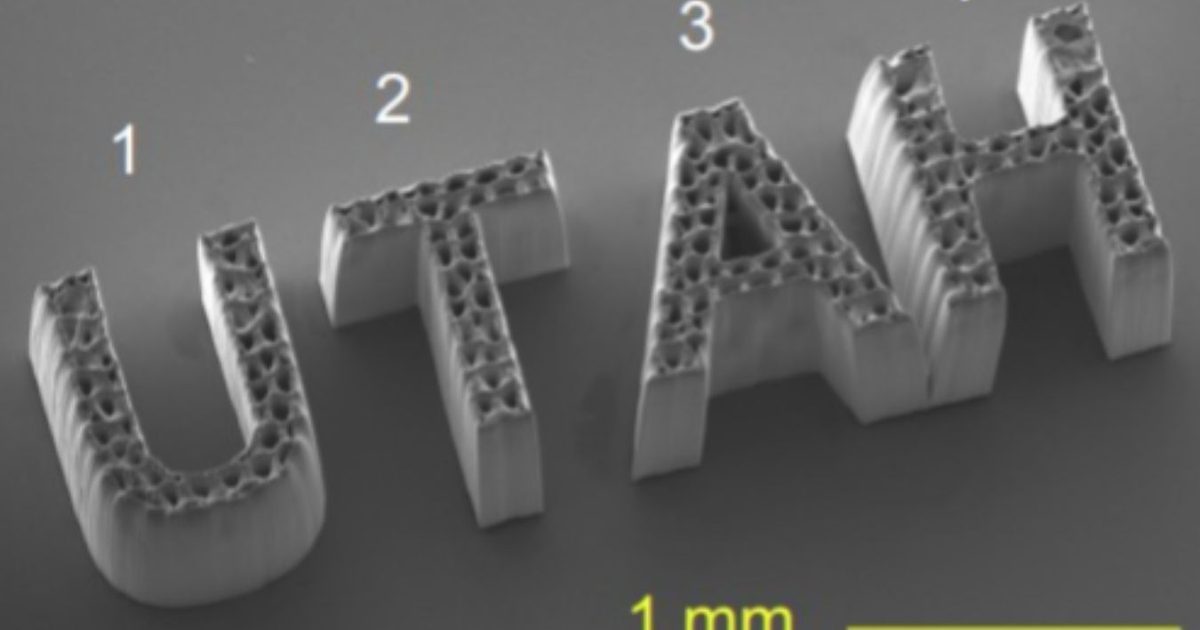
A 3D printer that can make a structure in about 20 seconds sounds like a lab claim wearing a cape. The clever bit is real. The catch arrives before anyone starts dreaming about instant replacement parts.
University of Utah researchers have demonstrated a holographic 3D printing technique that hardens tiny structures in one exposure instead of building them layer by layer. That one-shot approach could avoid the weak, leaky seams that stacked printing can leave behind. For now, though, this is a tool for microstructures, not a shortcut to printing whatever object pops into your head.
How one shot replaces layers
The technique borrows from photolithography, then pushes the idea into thicker material. A nanopatterned mask sits in front of the laser and shapes the light before it enters the print material.
That material is SU-8, a substrate whose polymer strands harden when exposed to laser light. After the targeted volume sets, the unexposed material can be washed away. Instead of tracing a shape through slice after slice, the system hardens the useful structure at once.
Where the catch shows up
The breakthrough is narrower than 3D printing sounds. The printer can control the length and width of a pattern, then extend that pattern through height. That makes it powerful, but still boxed in.
That limitation explains why the first demonstrations involve microtubule arrays and lattice patterns rather than tiny desktop ornaments. The approach suits intricate designs that need to run through a thick volume. Objects that require different geometry at different depths still need a more flexible version of the technology.


What this could print next
The useful version of this probably won’t resemble a home 3D printer. It looks more like a manufacturing tool for tiny parts where internal structure does the hard work.
The printed microtubules were tested for liquid movement through capillary action and for toughness under compression. That points toward lab-scale structures where small details have to survive real forces. The next step is clear enough. Researchers need to turn a fast extended-2D trick into true 3D control without losing the 20-second advantage.