

I adore Final Fantasy VII Remake – it was my 2020 game of the year – and I thoroughly enjoy its 2024 follow-up, Final Fantasy VII Rebirth (you can read my 8.5 out of 10 review here). I say this because I don’t think either game received great demos, and the finale of this remake trilogy, Final Fantasy VII Revelation, followed suit during Gamescom. Despite that, I’m not worried this threequel will fail to capture me the way its predecessors have. Though my story-focused demo didn’t do much for me, my Game Informer colleague Eric Van Allen had a much better time at Revelation’s Golden Saucer, and my interview with trilogy director Naoki Hamaguchi inspired the confidence I was looking for during the preview.
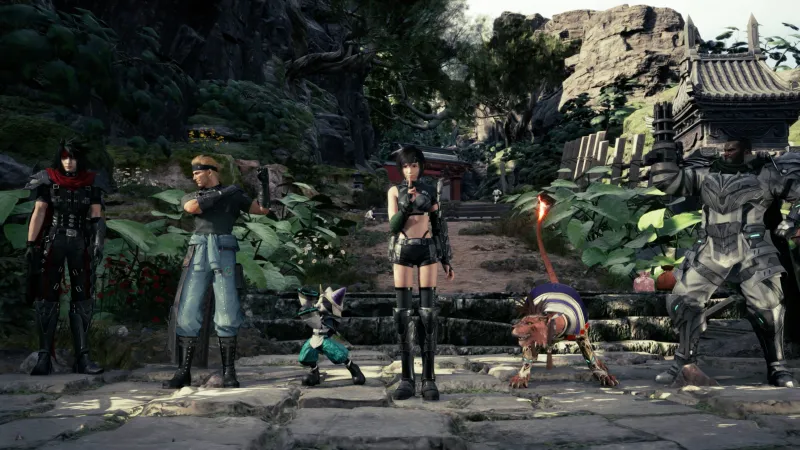
Admittedly, my demo disappointment might be my fault. We were given the choice to do whatever we wanted with Chapter 4 of Revelation, with most of the world open to us by way of the Highwind airship. Eric smartly headed straight to the Golden Saucer for minigames and more. “This is the demo for the new Queen’s Blood expansion, right?” I heard him proclaim as he entered those shimmering halls. He tells me the Golden Saucer remains the same as you remember it: laden with attractions and mascots, though the latter have now staged a workers’ uprising at the Saucer, and either Vincent or Cait Sith has to take charge and get things back in order.
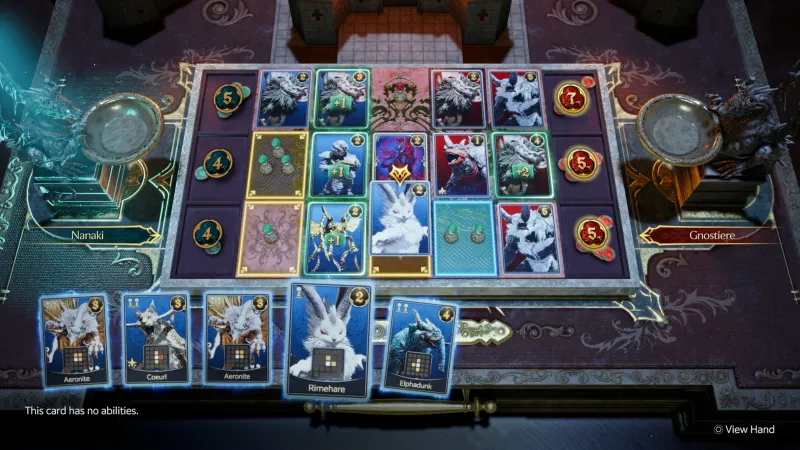
For the rest of the demo, Eric jumped between different minigames to see both the new and the old. Queen’s Blood has an interesting new trump card mechanic with a guaranteed starter card for your deck, and opponents are much more likely to have game-breaking advantages you’ll need to prepare for. Snowboarding is here, and is pretty fun to get into, though it — and the chocobo racing track — felt shallower in comparison to the changes made to Queen’s Blood. For lovers of minigames, though, there’s hardly a shortage of things to do in the Saucer, or even outside, as Queen’s Blood opponents still roam the world for Nanaki (our new card game collector) to challenge. The side game sickos (Eric) won’t be hurting for options in April.
Knowing he was heading to tackle some side-game content, I followed the main quest, but not before a quick tour of the Highwind’s facilities. Wize is your onboard go-to for playing Queen’s Blood on the ship, editing your deck, and more – he tells me Regina from Rebirth is back in Gongaga, asking me to visit her. Chocobo farmer Billy and his trusted chocobo Piko are now onboard as well, as is Chadley. Fortunately, Chadley is busy tracking down Weapons, so you’ll hear less from him in the world, but unfortunately, MAI is back and quite chatty. It might have been the result of this being a demo, but my word, I was inundated with notifications from MAI that not only paused the action, but took up the entire screen. One pop-up from her would close and another would arrive, over and over again – it was terribly intrusive and hopefully not representative of the final game, which Hamaguchi says can be golden-pathed in about 35 hours but stretched up to 100 or more for completionists; that’s a lot of MAI time.
Final Fantasy VII Revelation Preview Screenshot Gallery:
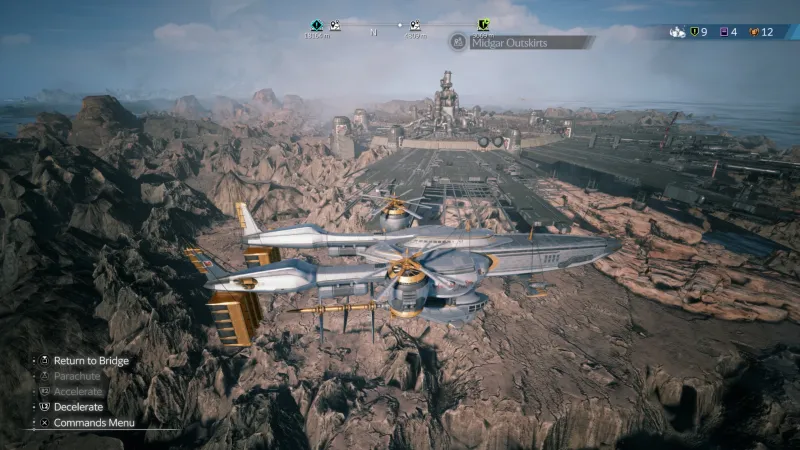
After this Highwind tour, I took the airship out for a spin. It controls about how you’d expect, similar to its nautical version at the end of Rebirth, but it’s far more exhilarating to view this world from the sky than the sea. The detail visible from the clouds is impressive, and seeing returning locations like Nibel, Junon, and more brings back memories I forgot I had of each place. The regions you explore down below look exactly as you think they would from above, and it’s easy to map in your head where you’ve been as a result. That said, a lot of Revelation’s playable world is filled with the aforementioned returning locations, and while I enjoyed them in my Rebirth playthroughs, I’m not dying to get back to, say, the opening Grasslands outside of Midgar. Hamaguchi says visual differences to the environments, added verticality, and new things to do have refreshed these locations.
“Obviously, where the story is at this point, you have the meteor in the sky, you have Weapons coming from the middle of the planet now rampaging around, so those have caused a lot of environmental changes,” Hamaguchi says in a group interview. “So, for example, there are some areas now which have been flooded and filled with water where they weren’t before. The Weapons have been attacking places and the land is now scarred and destroyed, so there are definitely some obvious visual changes that are the first things you’ll notice.”
But the team went further, changing how you explore each returning area. Hamaguchi says the concept of Rebirth was traveling and exploring this wide and vast land area, and that in Revelation, that concept has been expanded to include verticality. Not only is there exploration from the skies, with the ability to parachute down from the Highwind from virtually anywhere in the world, but revamped Chocobo mechanics, too. Chocobos in Revelation can now fly much higher and have an aerial dash that lets you accelerate quickly while flying. Hamaguchi says viewing these old places from new heights changes how you interact with them and explore. “I remember this feeling of great satisfaction when we were doing experiments with this and playing around with it,” he says. “When I first saw the view of the Grassland from the airship coming down and then flying through them on a Chocobo’s back, [it] felt completely new [even though] this is a game I’ve played more than anyone.”
While my demo felt like every door in the game was suddenly open with no guidance on what to do, Hamaguchi says the final game isn’t like that. He recognizes that there are many types of open world designs in games, and that Revelation isn’t the type to throw you into the world completely free, with no hints or instructions. “We didn’t go for that style,” he says. “We wanted to get a balance where it was you getting a certain level of hints and explanations and ideas about where you might want to go and what you might want to do, and if you start following those […] you start to see the options open up and it becomes freer and freer as you go.”
He adds that Revelation is built to be more approachable for those wary of open world games.
I ask the director about balancing the open world exploration with the very real stakes present narratively in Revelation – not only is it set days before the trilogy’s finale, but the incoming meteor sits ominously in the skybox of this world, threatening to destroy it all. Couple that with the massive Weapons trying to protect the planet and indiscriminately destroying anyone on it as a result, and it’s hard to wrestle with the idea of a Queen’s Blood match and the stakes Revelation sets.
“This is days before the final battle,” Hamaguchi says. “The idea is all of the party members having to find their motivation, their reason to fight. [It’s] a good time for the characters to really look inside themselves and examine the reason why they’re still fighting. What’s their motivation? Can they continue? Why should they continue fighting here? And so the idea is that all of the subquests, the side stories – they’re not just random things. [The] apocalypse is coming and [these characters] are trying to face off against their destinies before the end, and Revelation is really tied into that.”
He continues, “All of the side content is within the atmosphere of the world and the situation we’re in. We have very much thought about that in [Revelation’s] design. It’s not just some random side task – it’s all tied into why you’re there.”
That said, Hamaguchi says it’s part of Final Fantasy VII’s DNA to mix serious dramatic moments with light-hearted humor and funny side stories as well, so to expect those kinds of hybrid stories in Revelation.
That answer quelled my concerns I felt while playing Revelation, with its expanded planet to explore and even more activities to complete. Hearing that all of that optional content is aware that a giant meteor will smash into the planet in just a few days means the team is thinking not just about this narrative finale, but the mechanics that we engage with in the lead-up, and that has me excited.
After some airborne exploration, I dove Fortnite-style down to Wutai below, parachuting into the Japanese Garden-esque home country of party member, shuriken-throwing ninja, Yuffie. She recommends the team, short of Cloud and Aerith for reasons, go to Wutai because everyone there listens to her and will help their cause. Some significant story discussions happen here involving Glenn Lodbrock, a certain Viceroy, Godo Kisaragi, and others, but I’ll leave that for you to discover.
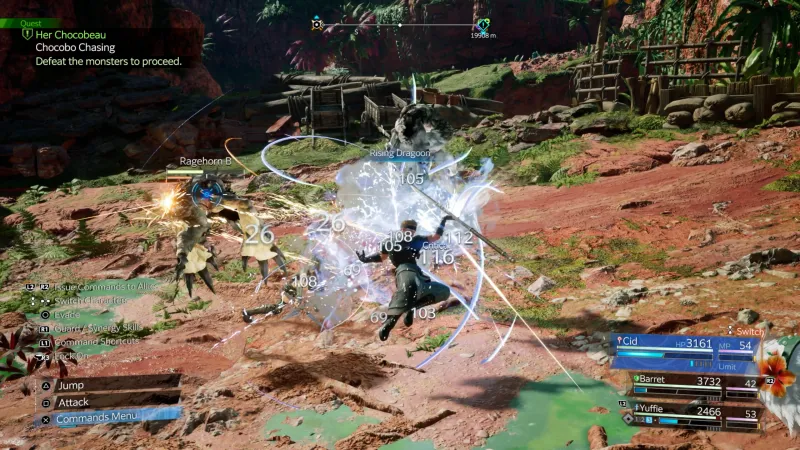
I quite enjoy Wutai’s visual design, and Yuffie’s remarks about her home are a delight as I explore the lush area. Engaging in combat here is fun, too, as it lets me try out party newcomer Cid’s “dashing dragoon” playstyle. Not quite as ranged as Barret, and not quite close-ranged like Cloud, Cid sits somewhere in between. He uses a spear to target and hit multiple enemies at once with large-swath swings, and it’s a role I didn’t know I needed filled on my Final Fantasy VII Remake trilogy team. What I experienced is barely a taste, though, but it whetted my appetite enough to indicate he’ll be a crucial member of my own party in the final game.
I’m sure the kind of emotional moments, exciting setpieces, and quieter character interactions are present in Revelation, even if none of that was featured in my preview demo. In fact, Hamaguchi says there’s one moment in Revelation that ensures those who didn’t cry in Remake or in Rebirth will have shed a tear by the end of the game. I have a few guesses about what that moment might be; the game launches in April, so I don’t have to wait long to learn if I’m right.