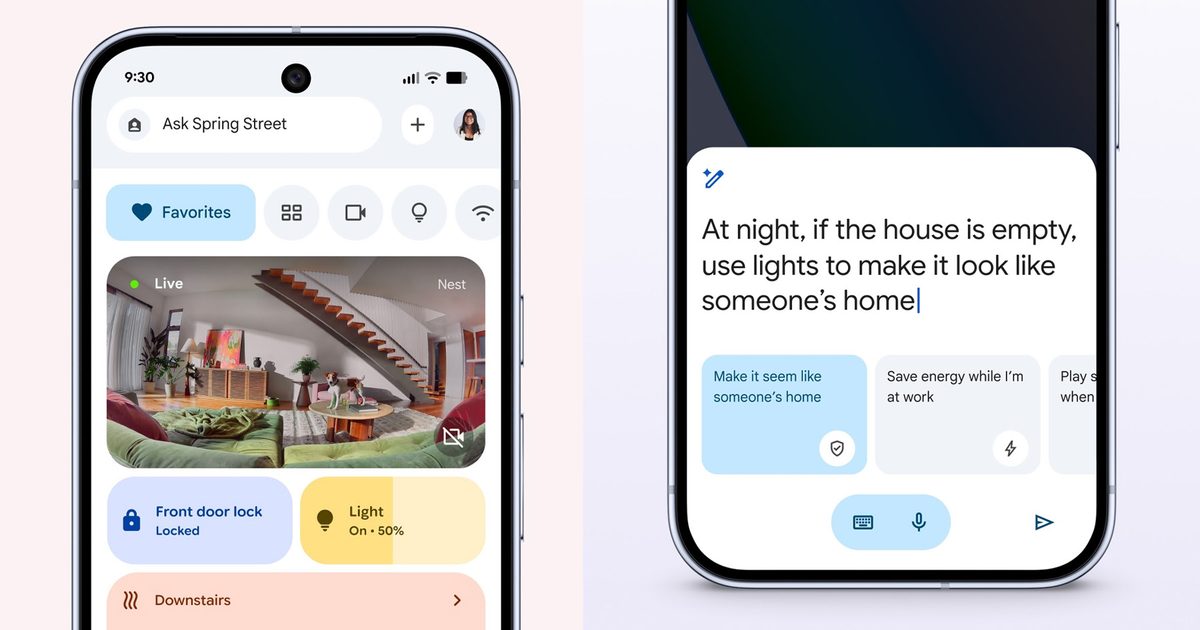
Google isn’t just tweaking Google Home this time; instead, it’s quietly turning it into something far more capable. And the focus is clear: give users real control over how their smart homes behave.
What’s new in the Google Home update?
The new update, announced on the official Google Nest Community, is all about expanding automation capabilities across supported devices, and it’s a much bigger leap than it sounds. Google has added a wide range of new starters, conditions, and actions, which means automations can now respond to far more specific triggers and states.
For example, users can now build automations around security system states, door lock conditions like jammed or forced open, and even binary sensor inputs such as leaks or contact detection. On the appliance side, things get even more practical, with support for starting, stopping, pausing, or resuming devices like washers, coffee machines, and robot vacuums.


There are also upgrades across lighting, climate, and media. Users can now trigger actions based on humidity levels, playback states, volume levels, battery status, or even smart switch inputs like long presses and releases. In simple terms, Google Home automations are no longer just about time-based routines. They are now driven by what is actually happening inside your home.
Why does this change how smart homes actually work?
The real shift here is control. Instead of rigid, preset routines, Google Home automations now behave more like dynamic if-this-then-that systems, reacting to real-world conditions. That makes everyday use far more practical, whether it is lights turning on when arriving home or devices adjusting based on temperature and usage.
There is also a clear push toward simplicity. With voice controls and AI-assisted setup coming soon, creating these automations will get easier. And that is the bigger picture. This update is not about more features; it is about making smart homes actually respond to how people live.