






Fire Emblem’s scale has been escalating for some time. From three Fates, to Three Houses, to numerous rings and now, a massive three-act entry for the Switch 2. Those ever-escalating aspirations have led to impressive new heights and ballooning scope. Fire Emblem: Fortune’s Weave is easily one of my favorite settings and stories in the series’ history, with memorable battles and characters, even when repetition and overabundance weigh it down.
Fortune’s Weave starts at the end of all things. After a quick character creator for a mysterious Pale Raven and an in medias res run through a world crumbling and haunted by the living dead, the player’s avatar and Fortuna – a goddess of fate – are some of the only survivors. To save the world, they’ll need to defeat the encroaching lord of the underworld, Balor, and they’ll need help to do it.
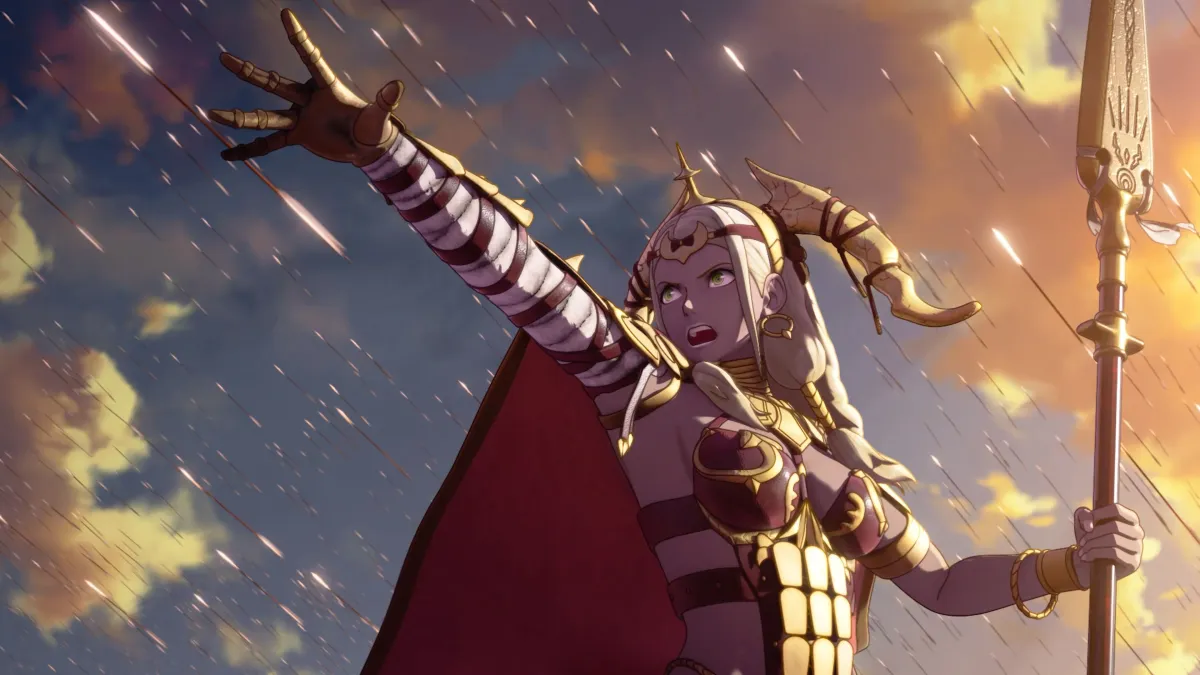
So, you retire to a chamber outside of time and zip back through history to the lives of four Flame Lords of Dagda: Cai, Theodora, Dietrich, and Leda. All have found their way to this continent’s capital in Dagsion, where Divine Emperor Solel is hosting the Heroic Games, with a promise that any wish will be granted to the ultimate victor.

Correct the causality of these fallen heroes, and they may survive and rally under your banner in the changed future for the final fight against Balor. You could go challenge the big bad at any moment, but the more lords you assemble, the easier time you’ll have. Showing up ready for the finale probably means bringing at least two lords, and their respective recruits, to the final campaign, and in my case, I wanted to get as many through as I could.
Fortune’s Weave takes on a three-part structure, with each lord getting an individual story through the Heroic Games. They each have their own reasons for fighting: the young Cai wishes to rescue his father from prison and imminent execution; Saraminian queen Theodora wants to reclaim land important to her people; songstress Leda has murder and revenge against her father’s killer on her mind; and Dietrich is just in it for the love of battle.
It’s a little overwrought to explain, but it lends itself well to the size of the tale Fortune’s Weave is telling. All four face trials and strife throughout the course of the games. Faustian bargains, shadowy organizations plotting in the background, and old secrets brought to light by the influx of every interesting and notable person in Dagda to its capital. It’s not required to play any of the routes, as you could go fight Balor on your own if you wish. But each lord’s story adds more context, nuance, and character to this huge tale. I loved moments where I’d see Dietrich and his spell-casting pal Fabio mention something during Cai’s path, and then get to see the events from their perspective when I played through them in Dietrich’s.
Playing through each route is a big task, though. They’re made up of chapters, which each have a big battle or two, with free time baked in for you to spend as you’d like in and outside of the capital. The scope starts small, with shared meals to build rapport within your unit, recruiting others to your team, or training skills at the arena. It soon expands out to encompass the entire continent, though, as you can roam around, fight overworld battles, explore dungeons, and use lord-specific mechanics like Theodora’s battalion recruitment or Leda’s tavern performances to gain resources and power.
This is where Fire Emblem: Fortune’s Weave starts to weigh itself down. Dungeon exploration, a returning mechanic from Echoes: Shadows of Valentia, turns Fire Emblem into a classic RPG dungeon-crawl with a small party, strike-to-engage exploration, and turn-based combat. It feels like a microcosm of big strategy battles, only they get repetitive and too frequent; I engaged with them for the first lord’s route, but moved to auto-battle soon after, as I was just going through the same motions for each fight in every dungeon.
Free time was most interesting when I was pressed against the clock to finish certain quests, acquire resources, and resolve paralogues before the deadline, but keeping up with the numerous weekly activities and checking in at home for any random events – often only signified by an inconspicuous ripple on my map in Dagsion – meant I was usually just going through the motions. During some periods I’d be stressed out, trying to build up support levels for a new Archer recruit while finishing enough side quests to get the renown level I’d need to get them on my team for a big battle with flying foes coming up. Other cycles, I was just in a loop: train, eat, auto-activities, repeat.
When it finally comes back to the bread-and-butter strategy of Fire Emblem, Fortune’s Weave is excellent. Overworld map fights are fairly straightforward, but the bookending fights of chapters are highlights, especially when they take place in Dagsion’s arena. Developer Intelligent Systems concocted some brilliant coliseum battles that have all the theme and flair you’d hope for: charging chariots, puzzling mechanisms, and special combat arenas that push you to utilize your units as best you can.
There’s no shortage of options for combat, as each unit archetype can go down interesting upgrade lines. In Leda’s path, I had the aspiring mercenary Mu train up into a deadly sword-wielder who could cut through anything with a strong critical strike. In Cai’s path, I secretly trained the lord in magic alongside one of his childhood friends, Thialla, so he could become a spell-slinging mounted Caldarius for the final fights of the Heroic Games. Fortune’s Weave eschews the weapon triangle to place more emphasis on what weapons can handle individually, like magic against armor or lances against horses, and a greater emphasis on Combat Arts makes training within a fighter’s specific strengths rewarding. Lords also pack their own Blaze Arts, like Leda’s spellsongs or Dietrich’s shadowstep, giving them fun tools to enable strategies and close out maps.
The opening act is great, and yet somehow only one part of the pie, as Fire Emblem: Fortune’s Weave still has two more acts to play out. After leading a lord to the end of their path in the Heroic Games, a second section unlocks, exploring their story in a war that breaks out not long after the Games’ conclusion. See them through that, and the lord – and any units they recruited – can join you for the final campaign against Balor, which has its own cycle of days, activities, and an extra layer of grand strategy over the top.
Pull it all together, and Fire Emblem: Fortune’s Weave is weighty to see through to the end; it took me over 130 hours to see credits, and I still missed some scenes and events. The payoffs are excellent, and certain story beats getting set up in Part One and paid off in Part Three were incredible. But doing so requires a lot of playtime, investment, and repetition. Dungeons never get more interesting or challenging, collecting specific resources can feel cumbersome, and even exploring the map and managing units starts to slow Fortune’s Weave down in its final hours.
What kept me going was the world and its characters. The Romanesque vision of gladiatorial combat, the plucking strings of vihuelas, and a world where gods walk among men all kept me enthralled, start to finish. The story of Fortune’s Weave starts small and grows massive over its runtime, but at its heart, this Fire Emblem asks what our mortality means for us. How do we build our legacies and histories, build up for our future generations, and what do we live for with our allotted time? And what is worth defending and protecting with that time we’ve been given?
Fortune’s Weave has an amazing soundtrack and gorgeous visual designs for its cast and the various classes they can take on. Coliseum fights never failed to excite, and some of them now rank among my favorite all-time Fire Emblem maps. Warriors like Fabio, Lilian, Mu, Anatolia, Dante, Talimun, and Orchel all grew on me through their support and banter, or just developed their own emergent stories in battle.
Support conversations and side quests dig deep into the world’s lore, as well. In Theodora’s route, characters explored the difficulty of abiding by their patron god Yu Phas’ command to never write down their histories, and whether adhering to their long-held practices would cause them to erode over time. Leda grapples with the vices of indulging revenge and what music can bring to those who have lost as much as she has, while Dietrich stumbles into fascinating bits about the wider world and its long-held mysteries.
The scope of Fire Emblem: Fortune’s Weave allows it to take massive swings at surprising, cool concepts and mechanics that feel fresh and interesting for the series. Packing them all into a single game might have made this the most intimidating entry to jump into since Fates, but putting it all in a single package with some excellent quality-of-life options, like cross-path progression boosts and side quest clears, helps smooth out the road for those who want to see everything.
I’ve no doubt that those who crave a slow-burn epic and can stomach the repetition for the payoffs will love this world and its cast of characters. Fire Emblem: Fortune’s Weave will easily eat up all your time for months to come, and it’s worthwhile to see these Heroic Games through to their conclusion.
