








The evolution of the operating system (OS) across several device generations has always been driven by necessity. However, with the rapid expansion of the AI agent ecosystem, it is evident that the legacy OS is struggling to catch up. The continued reliance on traditional operating systems to run AI infrastructures has introduced inefficiencies that often prevent AI models from reaching their full potential.
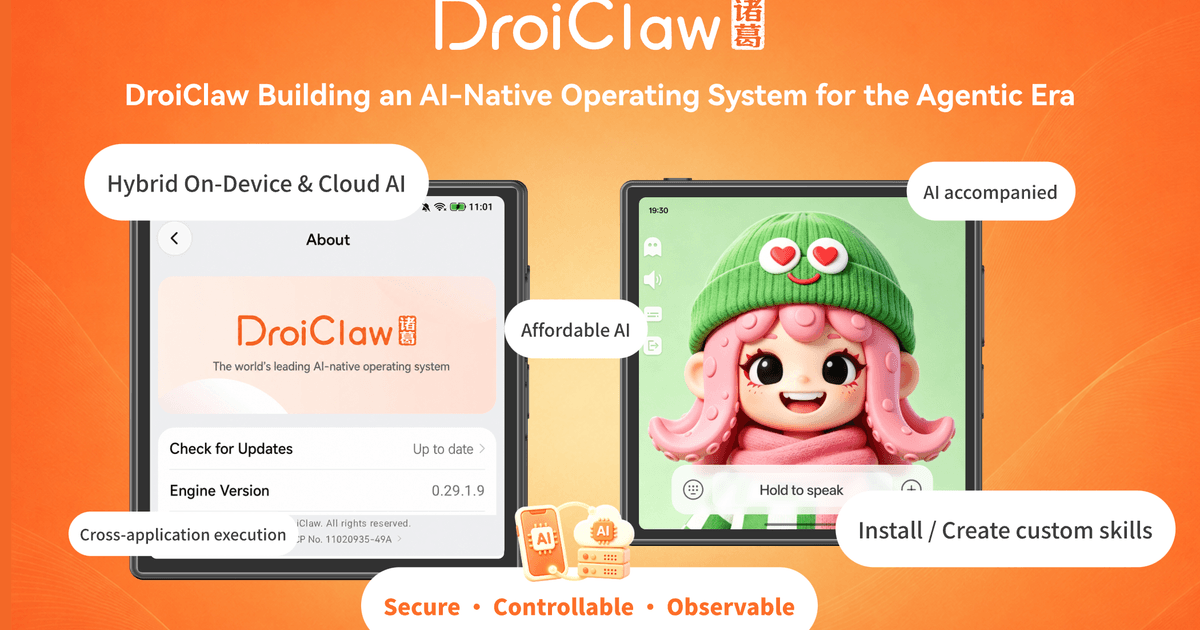
DroiClaw (Zhuge) is an AI-native operating system developed by Shanghai Droi Technology. It integrates AI into the underlying system architecture instead of relying on app installations to add AI capabilities. The OS accepts multimodal inputs, including text, voice, images, files, and visual information, enabling more natural interactions across different smart-terminal scenarios. By embedding AI directly into the system, DroiClaw aims to simplify how users interact with their devices while supporting a broader range of intelligent experiences.
What Makes an Operating System AI-Native?
In legacy OS, AI capabilities, like an assistant or a chatbot, are add-ons that can be installed on the system as apps. In other words, they don’t have AI capabilities natively built into their infrastructure. To get AI capabilities on a traditional OS, a user must install multiple AI-purpose-built apps, with each application typically handling only a specific function or workflow.
DroiClaw is not another tool or AI feature added to a conventional OS. It was designed around AI at the system level. The architecture, interaction model, model scheduling, data processing, agent capabilities, and user experience are all built with AI as the foundational element. Rather than treating AI as an additional feature, the operating system incorporates it into the core of how the device functions.
From Apps to an Agentic OS
On smartphones running traditional operating systems, users often need to open separate apps and complete multiple steps to carry out a task. DroiClaw’s core objective is to build an app-free Agentic OS ecosystem that moves beyond the traditional app-centered interaction model.
The smart terminal OS uses natural-language interaction and AI agents to understand user intent for a tailored, streamlined experience. By coordinating different system functions and services, the OS breaks down complex requests into smaller tasks and completes user-authorized operations, reducing the need to manually switch between multiple apps. Users can install skills from a skill library or create customized skills for specific tasks and workflows, allowing the system to adapt to different needs and usage scenarios.
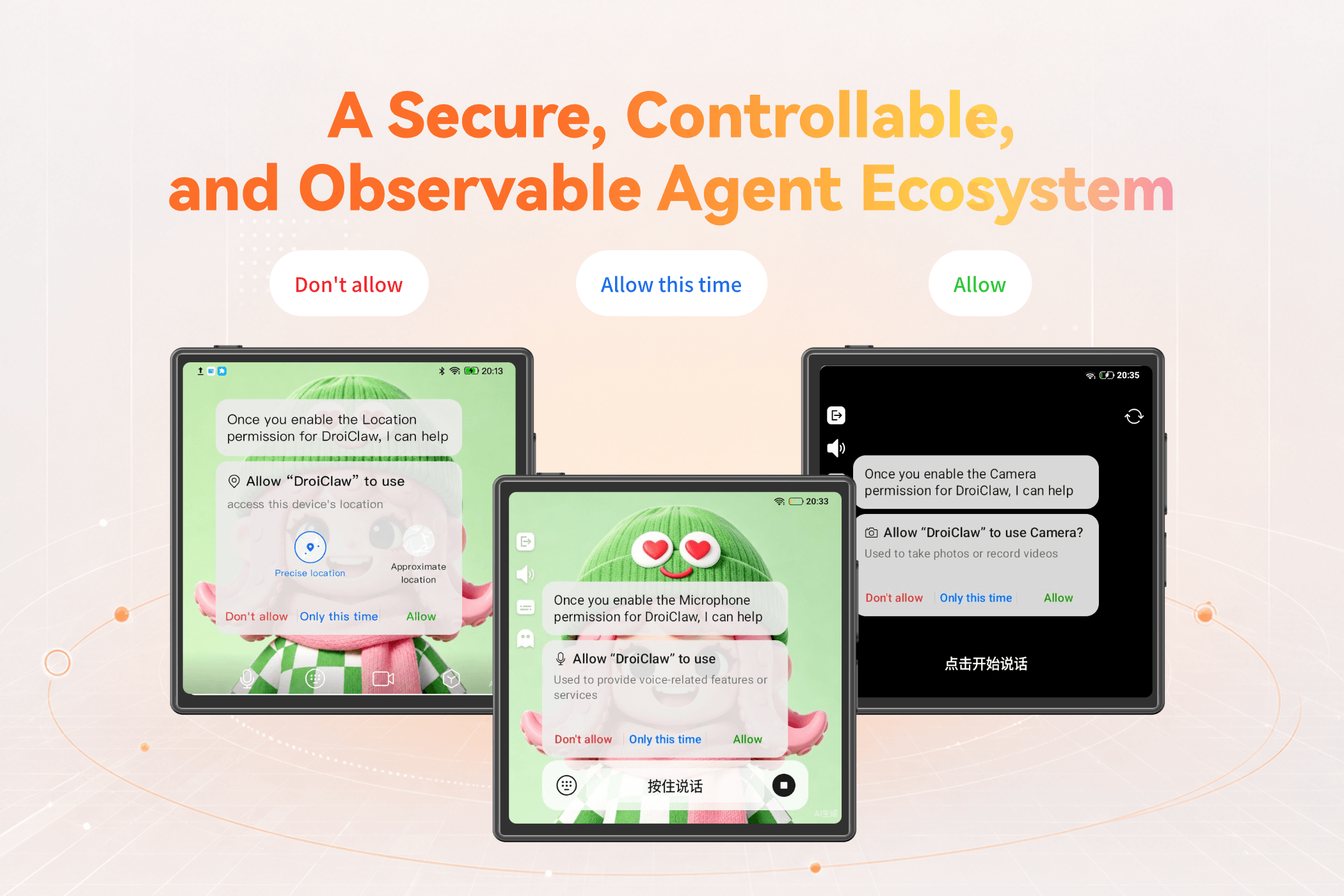
Although the shift from an app-centric operating system toward an intent-driven Agentic OS is intended to eliminate the inefficiencies of the former and make the completion of tasks less time-consuming, the authorization step allows users to remain in control of important actions before they are carried out.
Hybrid On-Device and Cloud AI
DroiClaw uses a hybrid architecture that combines lightweight on-device AI models with cloud-based large models to support different usage scenarios.
Under normal conditions, users primarily rely on cloud-based large models, which provide more advanced capabilities such as multimodal interactions, AIGC, complex reasoning, content generation, scheduled tasks, and skill execution. These cloud-based models are designed to handle more demanding AI workloads while supporting a broad range of intelligent functions.
On-device models mainly serve as a fallback in specific situations, such as when internet access is unavailable or cloud service credits have been exhausted. In these cases, the system can automatically switch to the local model to handle basic question-and-answer tasks, allowing users to continue accessing core AI functionality even when cloud resources are unavailable.
A Secure, Controllable, and Observable Agent Ecosystem
As the capability of AI agents grows from performing simple tasks to operating devices, accessing data, and coordinating services, users and ecosystem partners need greater visibility and control over data handling and transfer.
The vision of DroiClaw’s ecosystem is to make data processing and transfer more transparent through task and model scheduling and layered data protection.
Shanghai Droi Technology’s AI-native OS offers greater transparency and control through user authorization and controllable execution of automated tasks. Sensitive operations are handled only after the user permits them. The operational permission management system gives users greater visibility into agent actions and when permissions are required. This transparency is intended to help build trust in AI agents while allowing users to maintain control over how automated actions are performed.

Affordable AI and an Open Ecosystem
The biggest industry shift that DroiClaw hopes to achieve is bringing advanced AI capabilities to low- to mid-end, lower-priced smart terminals. This is a significant benefit for consumers since legacy OS often requires powerful hardware infrastructure to run on-device AI models, which can push device costs beyond the reach of mainstream users.
The first smartphones equipped with DroiClaw are priced at around RMB 1,099 (approximately $165). For comparison, flagship smartphones running on legacy OS with on-device AI capabilities typically cost around $800 to $1,300 (approximately RMB 5,425 to 8,815).
Shanghai Droi Technology’s AI-native OS is not intended to be restricted to a single hardware brand or AI service. It provides an open ecosystem that supports different hardware platforms and AI models, giving developers and users the flexibility to switch between AI models and add customized models. The importance of the shift toward open-source AI models has also been demonstrated by OpenClaw.
Conclusion
Shanghai Droi Technology was founded in 2008 and specializes in the development of operating systems and mobile internet ecosystem services. The company independently develops FreemeOS and DroiClaw, alongside a broader portfolio of digital services.
According to Shanghai Droi Technology, FreemeOS has received more than 200 million device installs across dozens of countries and regions. The company also works with more than 1,000 hardware and software ecosystem partners and serves multiple global markets. Building on that experience, DroiClaw is positioned to support the evolution of AI-native smart devices while making intelligent operating systems more accessible to a wider range of users.

