






The first meal you learn to cook in Crimson Desert is Clear Soup, a brothy mixture of simply water, meat, and lentils. It looks nice and is probably filling, but would no doubt be a bit simple and leave you wanting something with a little more depth of flavor. As it turns out, it’s the perfect allegory for Crimson Desert at large: a beautiful, exploration-rich open-world game that’s a clear technological achievement, hampered by a cornucopia of little frustrations and a stark lack of narrative depth.
In Crimson Desert, you follow the exploits of Kliff, the leader of a sort of fantasy peacekeeping corps known as the Greymanes, who help with the safety of the country of Pailune. But after an ambush, the company is scattered, and Kliff is killed, only for him to be revived by supernatural beings and set on a path to save the world from dark forces.
There’s a grand fantasy world to explore in Crimson Desert, filled with fascinating little cultures and wondrous sights – from a clockwork city where machine beings tend nearby farms, to a labyrinth of esoteric ruins floating in the sky. Crimson Desert is a visual and technical marvel at every turn, a beautifully realized world from a pure aesthetic standpoint. The entire world is rendered as one location, and you can, quite literally, see every inch of it from any high point. It’s breathtaking. But the first major downside that becomes quite apparent early on is that the game doesn’t have much of a story to tell or any major themes to impart.
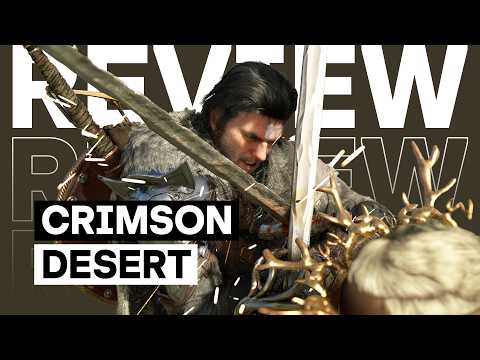
I can’t think of a better way to describe Crimson Desert’s main story, other than it’s simply a mess. The plot fluctuates from hard to follow to downright nonsensical at times, more focused on delivering a sense of spectacle and bombast than anything. But it also clearly wants to have these big emotional moments that are supposed to have some kind of payoff that just isn’t there. The best way to describe it is if you looked up a compilation of “Game of Thrones’ best moments” on YouTube. So you get all these admittedly cool sequences and big fantasy set pieces, but without any of the backing of real character growth and depth. That even applies to the main character, Kliff himself, who feels just one step removed from a silent protagonist. This means that despite the beauty of the world, there’s nothing to ground you in it or make you truly care about the things you’re doing.
The one exception here is reuniting all of the Greymanes, where the game’s sole emotional core lies. Seeing your camp come together and grow is undeniably satisfying, and there are some meaningful moments of bonding between Kliff and his allies. But the game makes all of this optional about a third of the way through – meaning you might miss most of it.
You’ll likely see a lot of comparisons between Crimson Desert, Breath of the Wild, and Dragon’s Dogma. The inspiration from those two titans of open-world games is clear, as Crimson Desert similarly has a minimalistic approach to everything. There are very few tutorials, requiring you to learn everything through experimentation and practice. The game doesn’t have any immediately available fast travel, instead requiring you to discover fast travel points through exploration. And there’s a heavy focus on puzzle-solving, using your myriad skills.
There are so many different features and mechanics in Crimson Desert that there’s no way I can properly describe everything. This is a game that wants to be everything, the textbook definition of an open-world. You have base building and soldier management as you rebuild the Greymanes. There’s crunchy melee combat that even integrates absurd wrestling moves. Realistic physics and complex Zelda-esque puzzles are scattered throughout the world. One encounters hundreds of little sidequests and contained stories to discover. Uncover dynamic relationship systems where you can bond with animals and NPCs. And there’s even dragon riding.
The number of things to see and do in Crimson Desert is utterly overwhelming. But there’s a real sense of discovery baked into the fabric of the world that’s unbelievably compelling. The quiet moments as I roamed the lands of Pywel were, by far, my favorite. Discovering a sentient tree with a hat I needed to steal for some magical beings. Or stumbling onto a Spirit Knight boss that, when defeated, unlocked a wild new weapon ability that drastically altered my playstyle.
It’s these moments of surprise and wonder that make Crimson Desert shine. But outside of that, unfortunately, the game often feels like it’s simply stretched too thin trying to do too many things and not really refining any singular idea.
Take combat, for example. The game’s action combat initially feels frenetic and intense, in line with a straight-up action game, getting drastically more interesting in the late-game when you’ve unlocked a wide array of skills. But before you reach that point where everything’s unlocked, it’s surprisingly tedious. Each enemy you kill typically has a short execution animation that plays out, something that’s not bothersome against a few enemies, but becomes aggravating when you’re trying to take over an area and fighting off 40 enemies. This makes taking over bases a slog. And while there are a handful of enjoyably challenging boss battles, there are just as many, if not more, that are miserable affairs.
Bosses have huge, wide-reaching attacks and very short windows for when you can cause damage, compounded by small arenas that plaster a big “return to the battle area” warning if you stray an inch or two in the wrong direction. Crimson Desert really wants you to explore and find Abyss artifacts to upgrade Kliff’s stats and buy new combat abilities, as well as gather resources through mining, woodcutting, and more. And if you aren’t upgrading everything accordingly, you’ll get easily beaten into the ground by bosses, but without a tangible stat or levelling system, it’s hard to tell if you’re actually prepared enough for a given mission or boss.
I can confidently say Crimson Desert has some of the most nauseatingly frustrating boss battles I’ve ever encountered, except for the handful that bizarrely can be beaten immediately with very specific gimmicks. The more abilities you unlock, the messier combat can get, too, as you have over a dozen different button presses to keep track of for specific attacks.
Then there’s the healing system, as the only way Kliff can heal is with food in his inventory, or meals you’ve cooked at bonfires. But bosses make you blow through your food items, meaning you’re constantly on the hunt for new food, spending hours gathering items and cooking them up. And therein lies the crux of my major issue with Crimson Desert – how much of the game feels like it’s simply wasting your time. It’s a game I played for 100 hours that probably should have been more like 50 to 60.
That’s largely because, like with the cooking, nearly every facet of the game feels intentionally designed to drag things out in a way that’s not enjoyable in the slightest. I appreciate the emphasis on exploration, but that lack of easy fast travel gets truly aggravating when you’re spending 20 to 30 minutes riding between quests. Locations where you solve puzzles to unveil Abyss artifacts can also be used as fast travel, but only if they’ve been solved. This means if you can’t figure out a puzzle and need to come back later, you won’t get a fast travel point.
Similarly, if you want to upgrade your gear, you need to spend time grinding out materials, cutting down trees, hunting for ore, etc. Even the very design of quests feels needlessly drawn out. For example, early in the game, you take a quest to learn how to dye clothes, following an ally to the shop, and then learning that they moved the cauldron you need to the city. You go to the city and use the cauldron, but then have to travel all the way back to the shop to use the dye. A quest that could have quickly been over in a matter of minutes ended up taking me 15, and that’s not an isolated incident – as that kind of design is spread across the entire game.
I might not have as much of a problem with it if there were an interesting narrative component, but as I said earlier, there’s nothing truly compelling happening with most of the game’s storytelling. Most of these sidequests you’re doing for the tangible items and equipment, or the reward of adding another inventory slot. The limited inventory and management are other issues you constantly have to grapple with, like making frequent trips to towns or camps to unload items. These little frustrations and issues with Crimson Desert quickly start to pile on and add up into something that becomes aggravating.
Crimson Desert’s true problem is that it’s simply overdesigned – there are too many moving pieces. Even as in-depth as I’ve gone, there’s still a half-dozen systems I haven’t touched on, like trading and banking. And perhaps most crucially of all, not all of that is fun. I adored running around Pywel and poking my head in ancient ruins, but that enjoyment was constantly brought to a grinding halt by an oppressive boss battle that took me two hours, an inscrutable puzzle with a solution that required an ability I didn’t yet have, or wonky controls that would send me careening off the side of a cliff to my doom, forcing a respawn. And while I didn’t find Crimson Desert to be an overly buggy experience, especially for a game this size, I did have five hard crashes in my time and a handful of bugs, like my wagon getting completely stuck in a building, forcing me to go back to camp and pick the option to retrieve it, then do the mission all over again.
I wish Crimson Desert had stripped away some of its superfluous systems, simplified the combat, and really honed in on exploration and puzzle-solving. The quiet moments atop mountain peaks and wandering through bustling city streets, with the little stories therein, are truly something special. However, the game’s lack of a meaningful main narrative and overreliance on padding things out undoubtedly hurt it.
But, more than anything, there’s a foundation with Crimson Desert that I hope can be built upon, and considering this is Pearl Abyss’s first single-player game, I wonder how much of this can be chalked up to growing pains. The studio clearly took liberal inspiration from other games, but I hope that there can be something more looking toward the future. Crimson Desert has something special buried beneath its surface, if all those unneeded layers can be cut out.


